
When Anxiety Strikes

By Roz Jones

Panic attacks can be the bane of your existence, and can make caring for a loved one or even living your daily life extremely daunting. Never knowing when – or why – an attack can hit makes life unpredictable. Searching for a way to control your anxiety is a natural step to take. 

Most anxiety attacks come on suddenly – however, there are usually warning signs. It may only be a few seconds’ warning, but if we try to identify the signs, we may be able to lessen our symptoms. Some people experience chest tightening, lightheadedness, or shaking – all are the immediate signs of a rush of adrenaline. Adrenaline is one of the main identifiable reasons for an anxiety attack.  

As soon as you feel an attack beginning to develop, stop what you are doing. If you’re driving, pull over. If you’re standing or walking, sit down. As the attack begins to flower, take slow, steady breaths. Breathe in for five seconds, and out for five seconds. One of the main things people do when they are experiencing an anxiety attack is to breathe in short, sharp gasps; by slowing and focusing on your breathing, you are distracting your mind and resetting the scales. 

Keep breathing in this fashion. If necessary, close your eyes and tilt your head back so you have a clear throat passage for air to move through. You may also find some form of self-comforting useful; try rubbing the side of your wrist with a fingertip. Remain calm, focus on your breathing and rest until the feeling has passed.
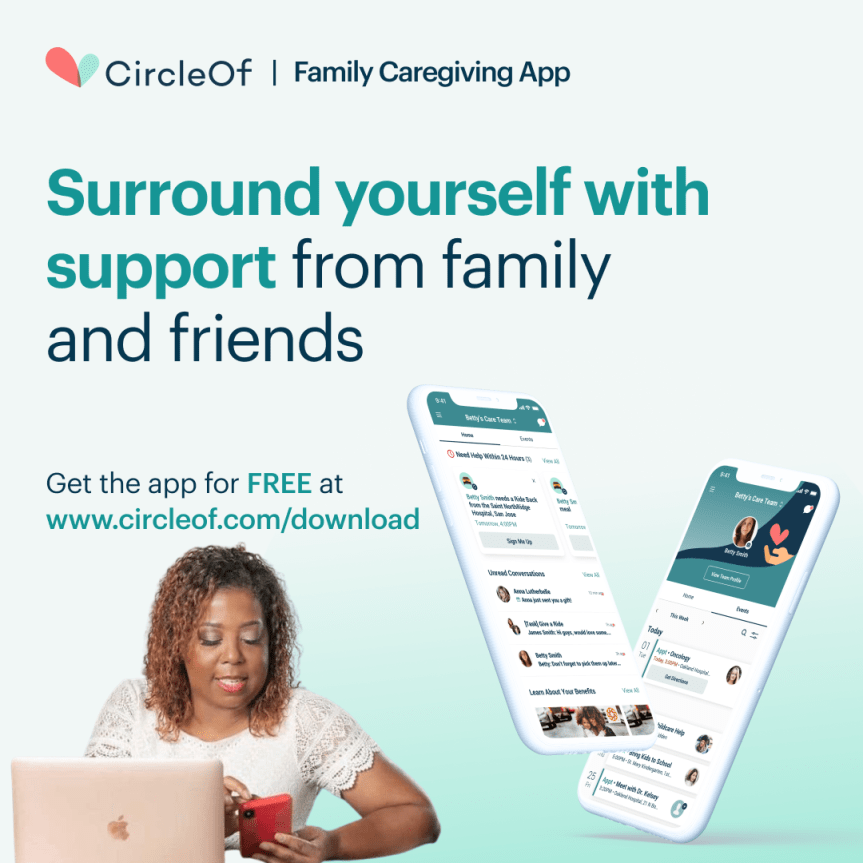
It’s here, I am so excited to share a new caregiver app called Circleof….This app will allow you to surround yourself with resources and experts from your community including ME!!!! As you are looking through the app, you will see my familiar face. I’m excited about this partnership and new ways to support you as you support your loved one. Here’s the link so you can explore the app. I would love your feedback and spread the word by sharing the link to family and friends.

Medicare Open Enrollment starts October 15th!

Navigating the Medicare Open Enrollment process can be confusing and difficult your first time, and I want to help out! For caregivers and their loved ones who are in need of advice and help planning their Medicare enrollment, I’m offering a discounted counseling session for just $97 through the end of October! Go to https://rozjonesent.com to sign up!

Interested in making your own contribution to the Caregiver Cafe? There are guest blog spots open for October, November, and December. Email assistrozjones@gmail.com for more info!

Visit http://www.rozjonesent.com for more information on addressing mental health as a caregiver and check out my upcoming book!
Knowing Your Triggers and Dealing With Them

By Roz Jones

Most sufferers of anxiety disorders have one or more “triggers” which can set off an attack at a moment’s notice. These triggers tend to be associated with the specific source of their anxiety – whether it be health, money, or any of a wide range of issues – and become identifiable to the sufferer within a short time of becoming active.  

For any given sufferer of an anxiety disorder, their triggers are a serious issue. The first time most sufferers become aware of their trigger is after it has occurred. For a sufferer of health anxiety, it may be a mere word that describes a symptom. The trigger commences a chain of thought in the sufferer’s mind that ends with a full-blown anxiety attack – which can last for some time and have long-ranging effects. 

Even for those without anxiety disorders, there can be circumstances or things that happen or that others say that cause us to feel uncomfortable, stressed, or maybe a little anxious. The same lesson can be applied to try to learn from these experiences to help us grow despite our triggers. It’s also important for us as caregivers to recognize that this may happen in our loved ones, help them recognize it in themselves, and learn ways together to prevent stressful or uncomfortable circumstances.

It is important for any sufferer to look back in the immediate aftermath of an attack and think about what must have been the trigger. Revisiting this may hold its own fears – if it triggered an event before, what’s to say it will not do the same again? Usually, it is the fact that anxiety attacks are not sustainable. By doing this in the aftermath, it is possible to see the trigger for what it was, and although it may not be permanently deactivated it is possible to forestall it happening again. 

When you know your triggers, it is possible to deal with them by excising them from your daily life – although this only works short-term – or by exposure therapy. Eventually you can prove to yourself that the trigger only has short-lived power, and that you are stronger.

It’s here, I am so excited to share a new caregiver app called Circleof….This app will allow you to surround yourself with resources and experts from your community including ME!!!! As you are looking through the app, you will see my familiar face. I’m excited about this partnership and new ways to support you as you support your loved one. Here’s the link so you can explore the app. I would love your feedback and spread the word by sharing the link to family and friends.

Visit http://www.rozjonesent.com for more information on addressing mental health as a caregiver and check out my upcoming book!
Self-Care Sunday: Dedicate One Day Each Week to Yourself pt 2

By Roz Jones

Last week, we talked about ideas for establishing a self-care routine and why it’s so important. Here’s a few more things to keep in mind when coming up with your own Self Care Sunday.

Self-Care for Introverts and Extroverts

Something to keep in mind is that what you consider self-care might change depending on if you are more of an introverted or extroverted person. 

Self-Care for Introverts

If you are an introvert, you probably find that you are the most relaxed when you are alone. This doesn’t mean you want to be or should be alone all the time, but that you often need a little bit of time to yourself each day to recharge and gain your composure.

Have Quiet Solitude on Sunday – Self-care for an introvert can be as simple as just making sure you have some alone, quiet time on Sundays. You need this time to yourself to regroup and relax. It can be really hard when you go all day around other people and never give yourself this time.

Find Nature-Inspired Activities – Introverts also tend to enjoy time outdoors, again in a quiet and peaceful environment. Try to find some activities you can participate in that will encourage you to spend more time outside. 

Embrace Your Creative Side – An amazing way to practice self-care as an introvert is to do something creative. Learn how to crochet, write a poem or short story, color in an adult coloring book, or start painting.

Self-Care for Extroverts

Extroverts are more social creatures, getting their energy from being around other people. If you consider yourself an extrovert, you probably enjoy time with others more than time alone. But what does that mean for your self-care routine? Here are some tips for practicing self-care when you are an extrovert.

Enjoy Social Time with Friends – What might be a little more up your alley is scheduling in time with friends. What better way to practice self-care than spend time with those you love the most?

Volunteer Your Time – Looking for something more meaningful and fulfilling? You might like to volunteer somewhere as your self-care. Look into local community centers or animal shelters that are open on Sunday and see if they need any help.

Join a Local Club – Another social activity that helps with your self-care is joining a local club, like a book club. Not only will you be encouraged to read more, but you can get together once a week with your book club to chat and talk about the book. 

Tips for Your Sunday Self-Care Routine

Here are a few more tips for making sure you have a good Sunday self-care routine, and really understand what self-care means and how to avoid the common mistakes.

It Encompasses Emotional, Mental, and Physical Health

Self-care does not fulfill just one need in your life. Different activities provoke different benefits in your life, including helping with your emotional, mental, and physical health.

What works best for you is going to be something that helps you feel relaxed, de-stressed, improves your mood, and is something you absolutely love to do. 

Your Self-Care Needs Can Change Regularly

Just because you have committed to writing in your journal and meditating every morning for an hour as your self-care routine, doesn’t mean you have to do this forever. Sometimes, what you choose as your self-care activity changes, or you need to make adjustments based on your schedule.

Revisit what you are doing for self-care often. As your life and the seasons change, so will your self-care and what is actually going to benefit you the most.

A Common Mistake is Forcing Your Self-Care

This can’t be said enough – your self-care routine should not make you more stressed! This is a sign that you are forcing yourself to do something you don’t want to do and that it is doing nothing for you. 

It might be because your friend is participating in this form of self-care, or you read that it is a good idea. But remember everyone is different and everyone is going to benefit from different things.

It’s here, I am so excited to share a new caregiver app called Circleof….This app will allow you to surround yourself with resources and experts from your community including ME!!!! As you are looking through the app, you will see my familiar face. I’m excited about this partnership and new ways to support you as you support your loved one. Here’s the link so you can explore the app. I would love your feedback and spread the word by sharing the link to family and friends.

Visit http://www.rozjonesent.com for more information on staying healthy as a caregiver and check out my upcoming book!

Is “Mental” Health Really Just In The Mind?

By Roz Jones

Imagine you are asked to describe what depression, obsessive compulsive disorder, or bipolar disorder are. Would you say “mental health problems” or similar? Most would, and there is a general perception that these problems are purely based in the mind. There is still something of an attitude that people with mental health and anxiety problems should be able to “snap out of it” or get over it, just like that. Yet many mental illnesses actually have physical reasons. 

For example, clinical depression. A much-misused term, depression is now used to describe someone feeling a bit low. However, if someone has full, clinical depression, they will experience long periods of horrifically low mood, low motivation, and a general feeling of emptiness. A cruel illness, but one that is described as being mental, and a regular target for the “pull yourself out of it!” brigade. 

Yet, depression does have a physical basis. Depression is caused by a lower-than-average amount of serotonin in the body. Also known as the “feel good” hormone, serotonin controls the mood, personality, and feelings of an individual. If serotonin levels are low, the individual will experience depressive, low thoughts. This is a physical problem with mental evidence, but it is physical nonetheless – antidepressants work on increasing serotonin levels, and tend to have a decent success rate. 

Furthermore, preliminary scans have shown those with obsessive compulsive disorder have enlarged lobes at the front of the brain. These lobes control our worry and anxiety mechanism, and when enlarged, the anxiety goes into overdrive – resulting in what we know as OCD.  

So these mental illnesses are, more often than not, physical in basis after all – and one can no more “shake off” or “get over” a hormone imbalance than one can “shake off” a broken leg!

Visit http://www.rozjonesent.com for more information on addressing mental health as a caregiver and check out my upcoming book!

What is Self-Hatred?

By Roz Jones

Could it be possible you hate yourself too much? Self-hatred is more than simply not liking yourself. When you suffer with self-hatred, you’ll constantly put yourself down and feel like you aren’t good at anything.

Self-hatred and feeling like we are not enough can be especially difficult for those of us fulfilling caregiver roles for our loved ones. When we are responsible for taking care of both ourselves and others, we can feel as if we are never doing enough or “doing it right.”

Here, we’ll look at what self-hatred is, the impact it can have on your life, and how you can stop it in its tracks.

Understanding self-hatred

Self-hatred is basically like having a little bully sat inside your head. You will experience constant criticizing thoughts, pointing out your flaws and mistakes. Some common self-hatred thoughts you might experience include:

You’re a loser”
“Why did you even try, you knew you would fail.”
“You aren’t good enough.”
“Why can’t you just be normal?

You’ll put yourself down and compare yourself to others frequently. Self-hatred tends to develop over time and is triggered by more than one event.

How can it impact your life?

Although self-doubt is healthy, self-hatred is not. If you struggle with self-hatred, it can have a devastating impact on your life. Often the feelings of self-hatred worsen over time and can lead to destructive behaviors as you try and numb the negative self-talk.

Many people who suffer with self-hatred go on to develop destructive behaviors such as cutting themselves, develop eating disorders, or turn to drugs and alcohol. It can impact every aspect of your life, including your relationships, your career, and the friends you include in your life. You may also stop caring about the things you used to enjoy and avoid things that make you feel better.

The impact it can have on your life makes it important to treat quickly, rather than ignore it. The question is, how can you eliminate self-hatred?

Ways to eliminate self-hatred from your life

There are many ways to eliminate self-hatred from your life. Learning how to tame your inner bully is a great first step. So, when you notice that inner voice telling you negative things about yourself, switch it around. Stop those negative thoughts in their tracks and turn them into a positive.

So, if your inner bully says, “You aren’t worth anything,” switch it to “I may feel like I am not worthy, but I know that I am.” The more you counteract the negative thoughts with positive ones, the more positive your mind will become.

You can also make a list of all your strengths. If you struggle to come up with some, ask those closest to you. When you focus on your strengths, you won’t be too caught up in your weaknesses.

Finally, work on building up self-compassion. That is, treat yourself the exact same way you would treat a good friend. As a caregiver, you are excellent at helping out and lifting others up, so turn these skills on yourself. Would you beat a loved one up for making a mistake? If not, why do it to yourself?

Overall, self-hatred can be a powerful thing to overcome since it builds up over time. However, the tips above can help you to start to quiet your inner bully and develop a little more self-compassion.

Visit http://www.rozjonesent.com for more information on building yourself up as a caregiver and check out my upcoming book!