Rational Reactions to Challenging Situations


By: Roz Jones

Rational and reasonable, at least linguistically, are synonymous. In fact, Webster uses these words to help define each other. 

Rational- Having or exercising the ability to reason: Of sound mind: Consistent with or based on reason (Webster’s New Riverside University Dictionary, 1984).

Reason: Within the bounds of common sense. Not extreme or excessive. The capacity for rational thought, inference, or discrimination (Websters New Riverside University Dictionary, 1984)

Our emotions are a reflection of our perceptions of what’s going on around us, and in turn they lead us to externally display one or more patterns of behavior in reaction to that stimuli. In any given situation, our emotions are going to have an impact in how we react. 

When these situations are especially challenging it can be difficult to maintain rational thought patterns and behavior within the confines of reason; as portrayed by Portia. 

If this were true, then should I know this secret. 

I grant I am a woman; but withal 

A woman that Lord Brutus took to wife: 

I grant I am a woman; but withal 

A woman well-reputed, Cato’s daughter. 

Think you I am no stronger than my sex, 

Being so father’d and so husbanded? 

 Tell me your counsels, I will not disclose ’em: 

I have made strong proof of my constancy, 

Giving myself a voluntary wound 

Here, in the thigh: can I bear that with patience. 

And not my husband’s secrets?

(The Tragedy Of Julius Caesar. (n.d.). Retrieved from Opensource Shakespeare: http://www.opensourceshakespeare.org/views/plays/play_view.php?WorkID=juliuscaesar&Act=2&Scene=1&Scope=scene)

Even though stabbing yourself in the leg is neither reasonable nor recommended, this one scene of Portia’s highlights the major points of remaining rational during a challenging situation. 

  • Remaining calm in a high-pressure situation
  • Maintain rational detachment
  • Be attentive
  • Recognize your limits
  • Be mindful of your own actions

Remain calm

Notice how Portia isn’t yelling and screaming at Brutus. She’s completely calm. She knows Brutus is up to something because she can clearly see the effect it’s having on him physically, how it’s weighing him down, so when she confronts Brutus and puts herself in this situation, she remains completely calm.

Maintain rational detachment 

Portia refers to her breeding and her choice of husband here as well. She’s calmly bringing up her, basically, credentials as she sees them. She has some authority here, though not very much, but she’s using what she has rather than taking the situation personally. Although she speaks about how Brutus’s treatment of her is affecting her personally, she’s not expressing that in an overtly emotional way in this particular scene. 

Portia is attempting to diffuse a situation that Brutus is in, and she know that if she reacts emotionally to the personal hurt, then she’ll get nowhere. Instead, she states her case with a degree of rational detachment. 

Be Attentive

Portia chose this particular moment in the garden with Brutus because she thought it to be a good time to address their situation. She’s mindful of her surroundings, and attentive to his current situation. 

Recognize your limits

Portia understands the limits of her standing as a woman in her society. Rather than making herself out to be too important to leave out of the equation, she pleads her case with Brutus by shining a light on her social and physical limitations, or rather, her limits as Brutus may see them as a man- even if she does mock his point of view just a tad bit. 

When she stabs herself in the leg, she recognizes that it’s painful, and addresses this fact in an attempt to portray her rational state of mind as a strength. Her use of her physical and social limits reflects a stoic, and rational, state of mind even though she’s probably very distraught. 

Be mindful of your own actions. 

Again, Portia is mindful of the fact that she’s basically ambushed Brutus just before he’s about to do something regretful. She doesn’t know exactly what he’s involved in, but she does have a feeling that it’s something horrible.

She’s completely mindful of her actions of ambushing Brutus, kneeling at his feet to beg, using every one of her tools in her arsenal to convince him to succumb to her will, even stabbing herself. At every phase she remains completely calm, and rational in her thoughts and actions. 

Rational thinking is the ability to consider all of the relevant variables in any given situation. Reacting rationally implies that your actions are a direct result of rational thought, even if some actions seem unreasonable. 

Portia’s display of feminine wiles in this scene depicts the Stoic philosophy of her day, and although it’s a play, it’s a perfect example of all of the components of rational behavior during challenging situations. 

Obviously, stabbing yourself is never reasonable. Remember that this is an artistic expression from Shakespeare, so certain components were included with the express purpose of highlighting the mistakes Brutus made. However, the principal stands. Rational behavior is best deployed in highly stressful situations, even if others like Brutus, do not behave rationally themselves.
How Better Self-Care Can Lead To Success

By: Roz Jones

Self-care is often brushed aside for things seen as more important; business meetings, social commitments, family obligations. While these things are important (and can in some cases contribute to self-care), it is important that we take time to ourselves when we need it. This personal investment will not be for nothing; in fact, self-care is important if we want to optimize our performance in any area of our lives. Taking the time to maintain our physical, emotional and mental health can lead to success in many ways.

Helps us to maintain perspective

Self-care, regardless of the form, allows us the time to reflect and therefore better understand ourselves as individuals. We are better able to identify our triggers and put things in to perspective, rearranging our priorities to understand what is important and what isn’t. This perspective contributes to a healthier life as we understand where stress is justified and where we should be more relaxed.

Helps us to keep positive

Self-care is great for our mental and emotional wellbeing. People who invest time in taking care of themselves are more likely to be more optimistic and see the silver linings in bad situations. It is an effective way for maintaining positive moods, rather than succumbing to darker emotions.

Improves our relationships

By investing time in ourselves, we are better placed to interact with and support others. Self-care allows us to maintain our own health and therefore put us in a good place to be able to engage with others and maintain strong relationships. 

Improves our work performance

While self-care is sometimes seen as indulgent, it often has a much broader impact that goes beyond our own lives. People who invest in self-care are more likely to be healthier, both physically and mentally, and are therefore better prepared to perform at work. They are likely to be more focused, more emotionally stable and form stronger, more positive relationships. All of these things are highly beneficial in the workplace and will lead to greater performance.

It does take time to invest in self-care, although the benefits far outweigh the price. Take the time to establish a good routine that includes self-care practices, whatever this looks like to you, and you will be sure to reap the rewards. Self-care is an important component of maintaining good health and should not be overlooked or disregarded. 

Using Humor to Resolve Conflict in Your Relationship

By Roz Jones

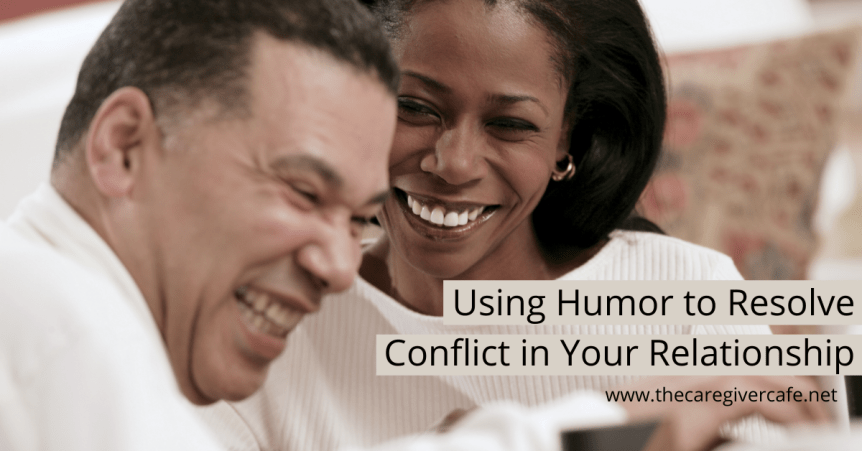
As caregivers sometimes conflicts can brew all day between you and the one you are providing care. There are times when as a caregiver the combatants are at a crisis point, and it feels like the entire office is holding their collective breath waiting to see what happens next. At this point, they’re ready for bloodshed, or at the very least, some very strong words. 

The last thing they expect is for one of the key players in the conflict to open their mouth and… make a joke?

Maybe it doesn’t feel like a resolution to the conflict, but actually, laughter goes far beyond being the clichéd ‘best medicine.’  How? First of all, laughter takes the tension out of the situation, which exactly is what’s needed to regain perspective, build stronger bonds, and yes, sometimes smooth over the differences. 

How then do you effectively use humor to resolve conflicts?

1. Make sure that both parties are ‘in on the joke.’ By keeping humor wholesome – not at the expense of the other person, you’re focusing on inviting them to laugh with you, rather than laughing at them. How can you tell if you’re doing it right? Humor is tricky, and so your best indicator of getting it right is to gauge the other person’s reactions. If they’re not laughing, chances are they don’t find it funny. Stop!

2. Check to make sure that you’re using humor as a defensive weapon rather than as a positive tool. If you’re using humor to mask emotions that you’d rather not deal with right now, then it’s time to put a flag on the play. Stop immediately and ask yourself what it is that you’re not dealing with and why. 

3. Work on that sense of humor. Every good comedian knows how to read their audience. The same goes for using humor with another person, especially in a situation that’s already a conflict. Watch the nonverbal cues. What language are you using? Keep the tone positive and light, and mean it. That means don’t use jokes as a means of cruelty. Lastly, consider what you might use as an inside joke. Inside jokes not only keep the situation light but create a deeper intimacy with whom you conflict.

4. Most importantly, be Playful! A little bit of silly fun is a good thing. Not sure how to tap into that kind of fun and crazy side? Explore humor in other ways so that you always have a repertoire to fall back on. Watch things you find funny on TV or in movies. Listen to jokes. Read the funnies. Find that side of you that likes to play and encourage it with creativity and fun. 

And no matter what, cut yourself some slack. It takes practice to be funny. Keep at it, and you’ll find your natural sense of humor, and be able to tap into it when you need to. That conflict won’t know what hit it!

De-Clutter Your Life; Your Family Will Thank You

You’ve spent a lifetime gathering personal belongings and acquiring the things that make your house a home. It’s hard to imagine not using them or having access to them when you need them. How many of these things have gone unused and unnoticed for a while? 


As we get older, we move past the accumulation stage of life and simply settle into living with what we have. Eventually what we have may become more than we will ever need again. It might be time to de-clutter and downsize. The more you hold on to, the more you leave behind for those you love to deal with. That’s not a very smart move. 

Aside from heirlooms and assets of value, our homes are generally filled with things that no longer serve us or we simply don’t need. At some point it makes sense to clear things out and start to streamline. Here are some practical dos and don’ts for de-cluttering your life to make things easier for your family. 

Do- Keep things of value: Your antiques, art, and family heirlooms have value. Don’t discard or give away items that are worth something financially or emotionally. 


Do- Sort through closets, drawers, and storage: These spaces tend to become black holes that contain unused and unimportant items. Tackle these spaces and reduce, recycle, and donate items you are no longer using. 

Do- Enlist your family’s help: Ask your family to help you determine what is worth keeping and what is worth letting go of. You don’t have to accept every recommendation they have but their impartial advice might help you make decisions easier. 

Don’t- Overthink things: People hold onto things for a lot of weird reasons. Don’t overthink the usefulness of something you haven’t looked for in years. If you aren’t actively using an item, consider getting rid of it. 

Don’t- Forget others need donations: Many of the things you aren’t using could benefit someone else. From a homeless shelter to helping a woman back on her feet, your unused items could help give someone else a brand new start. Be willing to donate gently used items to make a difference. 


Don’t- Be afraid: De-cluttering isn’t about losing your things. It’s about taking responsible action to streamline your life and be aware of how much you own and if it serves you. Don’t be afraid of letting go and clearing up space for easier living and a clutter-free home. 

Part of prepping for the later part of life is clearing out the clutter. Making things easier for the people who will have to manage your space for you after you are gone is kind and responsible. Do your part to de-clutter and get rid of the items that no longer have value or serve your needs. 

Using Investments to Augment Income and Medical Care Expenses

There are lots of ways to save for the future. From a simple savings account to a retirement fund, there are benefits and disadvantages for every plan. The best scenario is a diversified plan that covers a wide range of savings options. 

Investments are a savings strategy that can grow income that augments your retirement income and helps pay for out of pocket medical expenses. As we age, the bigger issues become health related. Having adequate coverage for a wide range of possibilities is valuable. We never know what sort of medical and other expenses we may have but some include:

  • Long-term hospital stays
  • Medication and ancillary equipment needs
  • Out of home placement
  • Estate management 
  • And more 

Making investments can help grow income passively while you earn income throughout your career. Once you retire, your sources of income work in conjunction with one another to preserve your standard of living. 

If you have medical coverage in place after retirement, there may still be out of pocket expenses. Leveraging investment income can help offset those costs and may have fewer penalties than accessing other sources of income. Your financial planner can help you evaluate the best investment plan for your budget. 

If you start investing in your younger years, you have a great chance of growing your income with simple and consistent investments. If you are starting later, no worries you can still grow your income and use strategies to make up for lost time. Either way, investing will help you generate income that supports your needs later in life. 

Here are some simple investment ideas for your consideration: 

  • Invest in the stock market
  • Invest in commercial property
  • Invest in tax-deferred plans
  • Invest in insurance products

Some investments can be liquidated faster than others when you need income. Others have penalties depending on when and how much income you collect. Your financial planner can help you diversify your investments so you have an assortment of options to grow your money and collect it when you need it. 

Investments are one of many tools you can use to secure your income for the future and plan for your end-of-life needs. Making small, simple investments over time will render big and important rewards when you need them most. These investments become assets that add to your estate and become part of your legacy from a life well lived.