

By Roz Jones
Caregiving has a way of making you look strong even when you are tired.
You are the one answering the phone.
The one remembering the appointments.
The one checking the medications.
The one making sure bills, meals, transportation, and follow-ups do not fall through the cracks.
You are holding it down.
But let me ask you something honestly:
Who is holding you?
In my previous blog, The Impact of Caregiving on Mental Health and Personal Well-Being, I talked about the emotional toll, physical stress, burnout, guilt, frustration, and exhaustion that can come with caregiving. I also shared the importance of self-care, support, boundaries, counseling, respite, and asking for help.
That foundation still matters.
But today, we need to go deeper.
Because caregiving is not getting simpler. For many families, caregiving now includes medical coordination, family communication, legal paperwork, emergency planning, financial decisions, and emotional support — all while the caregiver is trying to keep their own life together too.
The 2025 Caregiving in the U.S. report from AARP and the National Alliance for Caregiving found that the nation now has about 63 million family caregivers, showing just how many people are carrying care responsibilities in their homes, families, and communities.
So if caregiving has been weighing on your mind, your body, your sleep, your peace, or your patience, you are not imagining it.
Caregiving is real work.
And you deserve a care plan that includes you.
The Mental Load Is Heavy
People often notice the visible parts of caregiving.
Driving to appointments.
Cooking meals.
Helping with bathing.
Picking up prescriptions.
Managing the house.
Running errands.
But the invisible work can be just as heavy.
The invisible work is remembering what the doctor said.
It is tracking the side effects.
It is knowing which family member needs an update.
It is worrying about whether your loved one is safe at home.
It is thinking about what happens if the power goes out, if a storm hits, if the medication runs out, or if the hospital calls in the middle of the night.
It is carrying the “what ifs.”
That kind of mental load can wear a caregiver down, especially when everyone assumes you have it handled because you make it look handled.
But looking okay is not the same thing as being okay.
Stress Does Not Always Look Like Stress
Caregiver stress does not always show up as one big breakdown.
Sometimes it looks like snapping at people you love.
Sometimes it looks like sitting in the car longer than necessary because you need a moment before walking into the house.
Sometimes it looks like forgetting things, losing patience, feeling numb, or crying over something small because you have been holding in too much.
Sometimes it looks like guilt.
Guilt for being tired.
Guilt for wanting help.
Guilt for needing space.
Guilt for feeling frustrated with someone you love.
And sometimes it looks like resentment because you are doing the work, but other people are offering opinions instead of support.
According to 2025 caregiver research from the National Alliance for Caregiving, two-thirds of family caregivers report moderate to high emotional stress, and one in four report feeling isolated.
That isolation matters.
Because when caregivers feel alone, they often stop asking for what they need.
They push through.
They normalize exhaustion.
They tell themselves, “It’s just what I have to do.”
But no caregiver should have to disappear inside the role.
Your Body Is Talking Too
Caregiving does not only affect your emotions.
It can show up in your body.
Headaches.
Back pain.
Fatigue.
Stomach issues.
Poor sleep.
Changes in appetite.
Tension in your shoulders.
Feeling like you are always on alert.
That constant state of responsibility can take a real toll.
The CDC has reported that caregivers have shown higher levels of frequent mental distress and lifetime depression compared with non-caregivers, which is a reminder that caregiver health needs to be taken seriously.
Caregivers, your health is not optional.
Your appointments matter too.
Your sleep matters too.
Your meals matter too.
Your peace matters too.
You cannot keep treating your body like it is only there to get everybody else through.
Self-Care Is Not Enough Without Structure
Now let’s talk plainly.
Self-care matters.
But self-care cannot be the only answer when the caregiving system is broken.
A bubble bath will not fix the fact that you are the only one managing appointments.
A walk will not fix the stress of not knowing where the emergency documents are.
A journal will not replace a family conversation.
A nap will not solve a care plan that depends on one person doing everything.
Self-care helps you breathe.
Structure helps you sustain.
That structure may look like:
- Creating a written care plan
- Dividing responsibilities among family members
- Keeping a current medication list
- Organizing emergency contacts
- Knowing where important documents are stored
- Setting clear boundaries around time and money
- Scheduling respite care or backup support
- Having family care planning conversations before a crisis
This is the part many families skip.
They wait until something happens.
Then everyone is stressed, emotional, confused, and trying to make decisions quickly.
Caregivers need support before the breaking point.
Boundaries Are Not Being Mean
A lot of caregivers struggle with boundaries because they feel like saying “no” means they do not care.
But boundaries are not rejection.
Boundaries are protection.
You can love someone and still say:
- “I cannot be available every day.”
- “I need help with transportation.”
- “I am not able to cover these expenses.”
- “I need someone else to manage the pharmacy calls.”
- “I cannot keep missing work without a plan.”
- “We need a family meeting.”
- “I need rest before I can make another decision.”
That is not being difficult.
That is being honest.
And honesty is what keeps caregiving from turning into quiet resentment.
When you do not set boundaries, the care may continue, but the caregiver starts to suffer.
And eventually, that suffering affects everybody.
Emergency Planning Protects Your Peace
When we talk about caregiver well-being, emergency planning may not be the first thing people think about.
But it should be.
Because nothing increases caregiver stress like being unprepared during a crisis.
A hurricane.
A power outage.
A hospital visit.
A fall.
An evacuation.
A medication issue.
A sudden change in health.
These moments are already stressful.
But they become even harder when nobody knows where the documents are, who to call, what medications are needed, what insurance information is current, or what the plan is if your loved one cannot safely stay home.
When you have the list, the documents, the contacts, the supplies, and the plan, you are not scrambling from scratch.
You are responding with direction.
And caregivers need that kind of relief.
Caregiving Should Not Be a Solo Performance
Some caregivers are surrounded by people and still feel alone.
Because people may visit, call, comment, or check in — but that does not mean they are sharing the responsibility.
There is a difference between concern and help.
- Concern says, “Let me know if you need anything.”
- Help says, “I can take over the grocery order every Thursday.”
- Concern says, “You’re so strong.”
- Help says, “I’ll sit with Mom for three hours so you can rest.”
- Concern says, “I know this is hard.”
- Help says, “Send me the bill login. I’ll help organize payments.”
Caregivers do not just need compliments.
Caregivers need participation.
If you are the main caregiver, it may be time to stop asking generally and start asking specifically.
Do not say, “I need help.”
Say:
“I need you to take over prescription refills.”
“I need you to come every Saturday morning.”
“I need you to be the emergency contact when I am at work.”
“I need you to help pay for respite care.”
“I need you to attend the next care planning meeting.”
Clear asks create clearer support.
The Care Plan Includes You
Caregivers, I want you to remember this:
You are not just the person providing care.
You are a person who needs care too.
Your life still matters.
Your dreams still matter.
Your health still matters.
Your rest still matters.
Your relationships still matter.
Your future still matters.
Caregiving may be part of your life right now, but it cannot be allowed to consume all of you.
You can love your aging loved one deeply and still need help.
You can be committed and still be tired.
You can be grateful and still be overwhelmed.
You can be responsible and still need boundaries.
You can hold it down without breaking down — but only if the care plan includes support for you too.
Need Help Getting a Plan in Place?
Caregivers, please do not wait until you are exhausted, overwhelmed, or in the middle of an emergency to get organized.
Preparation is not panic.
Preparation is care.
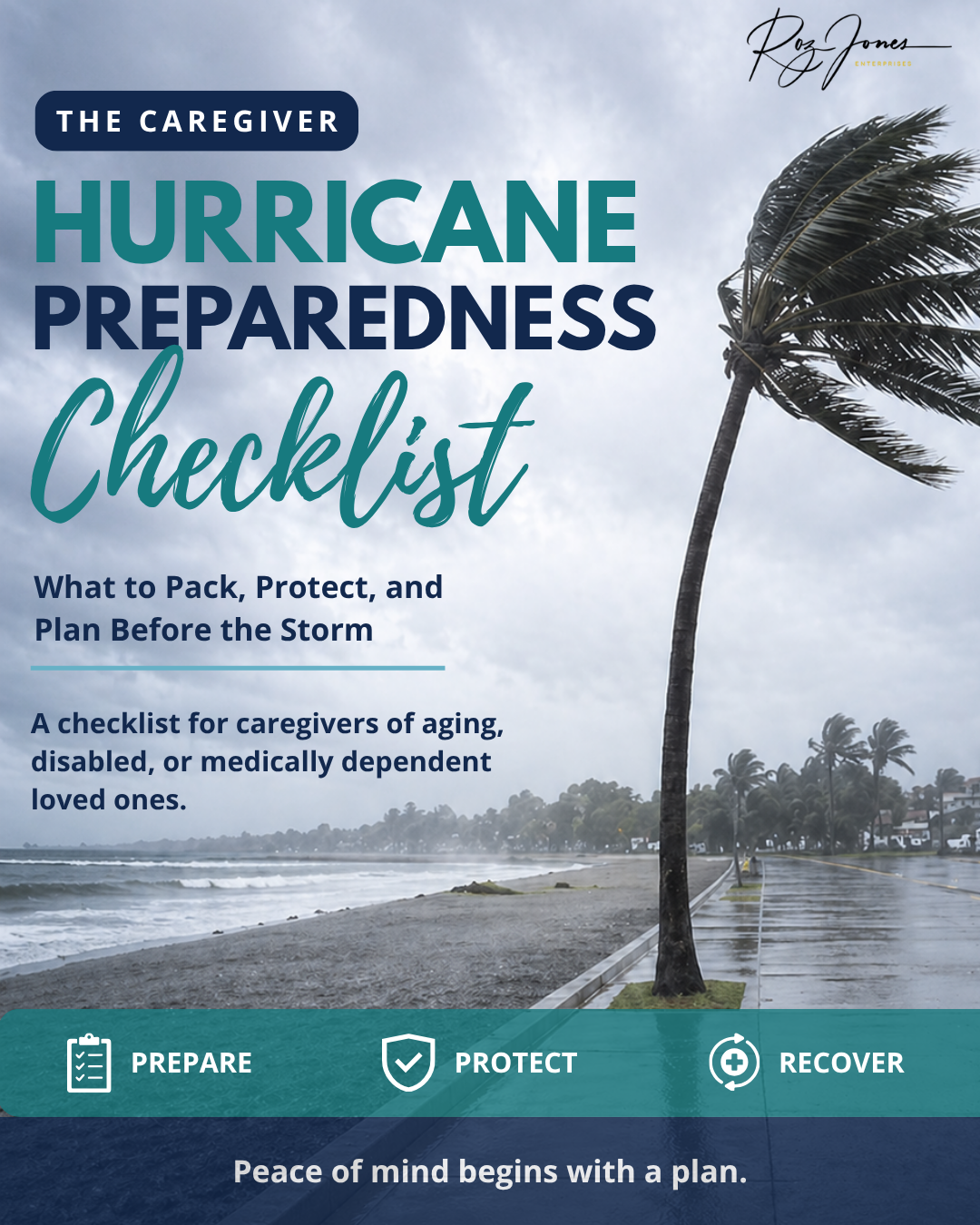
That is why I created the Caregiver Hurricane Preparedness Checklist.
For only $1.99, this checklist helps caregivers organize important details before an emergency happens, including medications, emergency contacts, documents, supplies, evacuation needs, and care information.
Purchase the Caregiver Hurricane Preparedness Checklist for $1.99 today and give yourself one less thing to carry from memory.
When You Can’t Do it All Give Roz a Call!

If your caregiving situation feels bigger than a checklist, I invite you to book a Family Care Planning Session with me.
Together, we can talk through what needs to be organized, what responsibilities need to be shared, and what support needs to be put in place so you are not holding everything alone.
Let’s create a care plan that protects your loved one and supports you too.
Subscribe to The Caregiver Cafe Weekly Newsletter!

1. YOU ARE NOT ALONE: The problems you face as a caregiver are experienced by other caregivers. Knowing that you’re not alone can be comforting.
2. Tools and Resources: Find caregiver stress management tools and gain perspective from other caregiver’s experiences.
3. LEARN TO: Ask for help, accept help when it is offered, and acknowledge yourself on this caregiving journey. Hear from experts on how to balance caregiving responsibilities by taking care of your needs and involving others to help manage the natural stress and isolation of being a caregiver.

