

By Roz Jones
There is a breaking point caregivers do not always talk about.
It may not look like yelling.
It may not look like falling apart.
It may not look like walking away.
Sometimes it looks like sitting in the car before going inside because you need one more minute.
Sometimes it looks like staring at your phone when it rings and feeling your whole body tense up.
Sometimes it looks like forgetting simple things because your mind is holding too much.
Sometimes it looks like saying, “I’m fine,” when you are tired, overwhelmed, and one more request away from tears.
That is the quiet breaking point.
And many caregivers know it well.
In my previous blog, The Intersection of Mental Health and Caregiving for an Aging Loved One, I talked about the emotional challenges caregivers often face, including stress, anxiety, guilt, grief, burnout, depression, and the importance of self-care, support, communication, respite care, counseling, and asking for help.
Because caregiving does not only change your schedule.
It can change your mood, your body, your relationships, your patience, your sleep, your peace, and the way you move through the world.
And if nobody checks on the caregiver, the caregiver can reach a breaking point quietly.
When You Are Always “The One”
There is a certain weight that comes with being the one everybody depends on.
The one who remembers the appointments.
The one who calls the pharmacy.
The one who notices the changes.
The one who keeps track of the paperwork.
The one who updates the family.
The one who shows up when everyone else is busy.
The one who is expected to be strong because you have been strong for so long.
Being dependable is a beautiful thing.
But being depended on without support can become exhausting.
Caregivers are often praised for being strong, but not always supported in a way that actually helps.
Someone may say, “You’re doing such a good job,” but never offer to sit with your loved one.
Someone may say, “Let me know if you need anything,” but disappear when you ask for something specific.
Someone may have plenty of opinions about the care, but no real availability to share the work.
That kind of imbalance can wear on your mental health.
Not all at once.
Little by little.
Caregiving Can Stir Up Everything
Caring for an aging loved one can bring up emotions that do not fit neatly into one category.
You may feel love and resentment in the same afternoon.
You may feel grateful for more time with them and still grieve who they used to be.
You may want to help and still feel trapped by how much help is needed.
You may feel guilty for needing space.
You may feel angry that other people are not doing more.
You may feel sad watching your loved one lose independence, memory, mobility, confidence, or control.
And if there is family history, caregiving can bring that history right back into the room.
Old wounds.
Old roles.
Old expectations.
Old arguments.
Old patterns where one person carries the weight and everyone else assumes that is just how it is.
Caregiving is not only about what is happening now.
Sometimes it also touches everything that happened before.
That is why your mental health matters.
Because you are not just managing tasks.
You are managing emotions, memories, responsibilities, and relationships all at once.
The Mental Load Can Become Too Much
People can see the visible parts of caregiving.
They can see you driving to appointments, picking up groceries, organizing medication, cleaning the house, answering calls, and helping with daily needs.
But they may not see the invisible work.
The constant thinking.
The remembering.
The planning.
The worrying.
The listening for changes in your loved one’s voice.
The checking your phone to make sure you did not miss a call.
The wondering what happens if there is a fall, a hospital visit, a hurricane, a power outage, or a sudden emergency.
That mental load can feel like too many tabs open in your mind at the same time.
And even when you are supposed to be resting, part of you may still be on alert.
This is why caregivers need more than encouragement.
You need systems that help you stop carrying every detail from memory.
A current medication list.
A folder for important documents.
An emergency contact list.
A plan for appointments.
A backup caregiver.
A storm plan.
A family care plan.
These are not just organizational tools.
They are stress reducers.
They give your mind somewhere to place what it has been trying to hold alone.
Mental Health Is Part of the Care Plan
Caregivers often put their own mental health at the bottom of the list.
You tell yourself you will rest after the next appointment.
You will call the therapist after things calm down.
You will ask for help after the hospital discharge.
You will take a break after the family meeting.
You will deal with your own feelings later.
But later keeps moving.
And the care keeps growing.
Your mental health cannot be an afterthought. Not when you are making decisions, managing crises, communicating with family, advocating at appointments, and trying to keep your own life together.
If you are more irritable than usual, that matters.
If you are not sleeping, that matters.
If you are crying more often, that matters.
If you feel numb, that matters.
If you are avoiding calls, forgetting things, feeling anxious, or feeling like you are always bracing for the next problem, that matters too.
You do not have to wait until you fall apart to take your mental health seriously.
Support is not only for crisis.
Support is how you stay steady before everything becomes a crisis.
Communication Has to Get Clearer
One of the hardest parts of caregiving is that people often assume the main caregiver has everything handled.
Especially when you are capable.
Especially when you are organized.
Especially when you are the one who usually figures things out.
But being capable does not mean you should be carrying everything alone.
Sometimes family members need direct communication, not hints.
Instead of saying, “I need help,” try saying:
- “I need you to handle pharmacy refills this month.”
- “I need you to take Mom to her appointment on Thursday.”
- “I need you to sit with Dad for three hours on Saturday so I can rest.”
- “I need us to meet and talk about the emergency plan.”
- “I need help paying for respite care.”
- “I need you to be the backup contact if I am unavailable.”
Clear communication may feel uncomfortable at first, but it reduces confusion.
It also makes it harder for others to pretend they did not know what was needed.
Caregivers do not need vague concern.
Caregivers need shared responsibility.
Boundaries Are Care Too
Boundaries are not a lack of love.
Boundaries are what help love survive the pressure.
You may need to say:
- “I cannot answer calls after 9 p.m. unless it is an emergency.”
- “I cannot keep missing work without a backup plan.”
- “I cannot pay for these expenses by myself.”
- “I can help with appointments, but I cannot manage everything alone.”
- “I need a break before I make another decision.”
- “I need other family members involved.”
That is not selfish.
That is honest.
And honesty protects both the caregiver and the person receiving care.
When caregivers have no boundaries, resentment can build quietly.
Exhaustion can become normal.
Stress can become part of your personality.
And the breaking point gets closer.
Emergency Planning Protects Your Peace
When we talk about caregiver mental health, emergency planning may not be the first thing people think about.
But it should be.
Because nothing drains a caregiver faster than a crisis with no plan.
A hurricane.
A power outage.
A hospitalization.
A fall.
An evacuation.
A sudden change in health.
These moments are stressful enough on their own.
But they become even heavier when nobody knows where the documents are, what medications are needed, who should be called, what supplies are required, or what the plan is if your loved one cannot safely stay home.
Preparation does not remove every worry.
But it does reduce the chaos.
It helps you move from panic to action.
It gives family members something clear to follow.
It gives the caregiver a little room to breathe.
That matters.
Because the person holding the care plan should not also have to invent the plan in the middle of an emergency.
You Deserve Support Before You Break
Caregivers, please hear me.
You do not have to wait until you are angry, exhausted, sick, resentful, or completely overwhelmed before you ask for help.
You do not have to earn rest by reaching your limit.
You do not have to prove your love by sacrificing your mental health.
You are allowed to need support now.
You are allowed to need a plan now.
You are allowed to say, “This is too much for one person.”
You are allowed to care deeply and still admit that caregiving is affecting you.
The goal is not to stop caring.
The goal is to care in a way that does not cost you yourself.
Need Help Before the Breaking Point Becomes a Crisis?
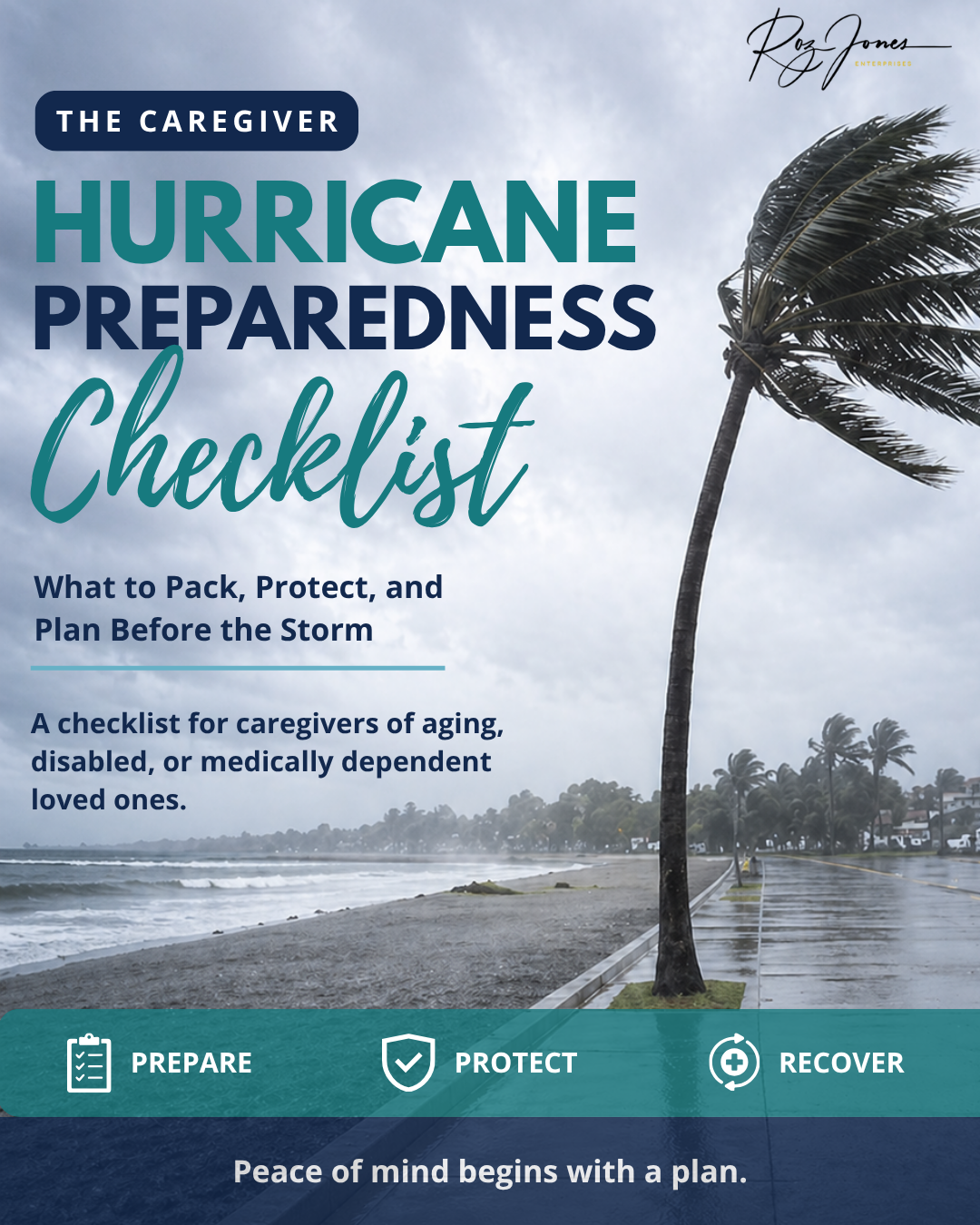
Caregivers, please do not wait until the storm is coming, the hospital calls, the medication list is missing, or the family is scrambling to figure out what should have already been written down.
Preparation is not panic.
Preparation is care.
That is why I created the Caregiver Hurricane Preparedness Checklist. For only $1.99, this checklist helps you organize the important details before an emergency happens, including medications, emergency contacts, documents, supplies, evacuation needs, and care information.Purchase the Caregiver Hurricane Preparedness Checklist today and give yourself one less thing to carry from me
When You Can’t Do it All Give Roz a Call!

If your caregiving situation feels bigger than a checklist, I invite you to book a Family Care Planning Session with me.
Together, we can look at what needs to be organized, what conversations need to happen, who needs to be involved, and what support needs to be put in place so you are not carrying the care plan alone.
You deserve support before you break.
Subscribe to The Caregiver Cafe Weekly Newsletter!

1. YOU ARE NOT ALONE: The problems you face as a caregiver are experienced by other caregivers. Knowing that you’re not alone can be comforting.
2. Tools and Resources: Find caregiver stress management tools and gain perspective from other caregiver’s experiences.
3. LEARN TO: Ask for help, accept help when it is offered, and acknowledge yourself on this caregiving journey. Hear from experts on how to balance caregiving responsibilities by taking care of your needs and involving others to help manage the natural stress and isolation of being a caregiver.

