

By Roz Jones
Caring for Others Without Disappearing
Written by Roz Jones
Caregiving will test parts of you that you did not even know needed support.
It will test your patience.
It will test your sleep.
It will test your schedule.
It will test your finances.
It will test your relationships.
And if you are not careful, it will test your sense of self.
That is why this conversation matters.
This blog is a continuation of Breaking the Stigma: Addressing Mental Health in Caregiving, because we cannot talk about caregiving honestly without talking about the emotional weight that comes with it.
The New Reality of Caregiving
Caregiving today looks different.
Families are smaller. People are living longer. Medical needs are more complex. Healthcare costs continue to rise. Many caregivers are working full-time jobs, raising children, managing households, and still showing up for an aging parent, spouse, former spouse, grandparent, auntie, uncle, neighbor, or loved one who needs care.
And then there is the emotional side.
You may be grieving who your loved one used to be while still caring for who they are now. You may be watching their independence shift. You may be carrying the pressure of being “the responsible one.” You may be tired of explaining to other people why you cannot show up the way you used to.
That kind of weight does not always look like a breakdown.
Sometimes it looks like snapping over something small.
Sometimes it looks like forgetting things.
Sometimes it looks like not answering your phone.
Sometimes it looks like sitting in the car before going inside because you need one more minute to yourself.
Caregiver stress is real, and it deserves to be taken seriously before it turns into burnout.
Being Strong Should Not Mean Being Silent
A lot of caregivers were raised to push through.
Handle your business.
Do not complain.
Keep family matters private.
Do what needs to be done.
And yes, there is strength in showing up. But there is also danger in pretending you are fine when you are not.
Mental health conversations in caregiving are not about weakness. They are about honesty. They are about naming what is happening before your body starts keeping score.
Because caregiving can bring up anxiety, sadness, guilt, resentment, loneliness, anger, and fear. Sometimes all in the same day.
You can love your aging loved one and still feel overwhelmed.
You can be grateful for the time you have and still feel exhausted.
You can be committed to their care and still need a break.
Both can be true.
What Caregivers Need Right Now
Caregivers do not need another person telling them to “just practice self-care” without understanding the reality of their day.
You need practical support.
You need emotional room.
You need systems that make life easier.
You need permission to stop carrying everything alone.
Here are a few places to start.
1. Start Checking In With Yourself Daily
Before you check the medication list, the appointment calendar, the missed calls, and the family group chat, check in with yourself.
Ask yourself:
How am I feeling today?
What do I need before I give more of myself away?
What feels heavy right now?
What can wait?
This does not have to take long. Even two minutes of honesty can help you notice when stress is building before it takes over.
2. Stop Waiting Until You Are Burned Out to Rest
Rest should not only happen when your body forces you to stop.
Caregivers often wait until they are completely drained before they allow themselves to sit down. But rest is not a reward. Rest is part of the care plan.
That may look like ten quiet minutes in the morning.
A short walk.
Sitting outside.
Turning your phone off for a set amount of time.
Letting someone else handle one task.
Taking a nap without guilt.
Small pauses matter. They help your nervous system come down from constant alert mode.
3. Build Boundaries Before You Build Resentment
A lot of caregiver resentment comes from unspoken limits.
You keep saying yes.
You keep rearranging your life.
You keep answering every call.
You keep stepping in because no one else will.
But if you never name your limits, people may assume you do not have any.
A boundary may sound like:
“I can take Mom to appointments on Tuesdays, but I cannot do every appointment.”
“I need help with meals twice a week.”
“I am not available for last-minute requests every time.”
“I need the family to make decisions together, not leave everything on me.”
Boundaries are not disrespectful. They are how you keep caregiving from consuming your whole life.
Preparedness Is Also Part of Your Peace
One thing I want caregivers to understand is this: stress does not only come from the daily responsibilities. It also comes from being unprepared when something urgent happens.
A storm.
A power outage.
A medical emergency.
A last-minute evacuation.
A medication issue.
A missed appointment.
A family disagreement about what needs to happen next.
When you are already stretched thin, emergencies can push you closer to your breaking point.
That is why planning matters.
If you are caring for an aging loved one, especially during hurricane season, do not wait until the weather alert comes through to start gathering paperwork, medications, emergency contacts, supplies, and transportation plans.
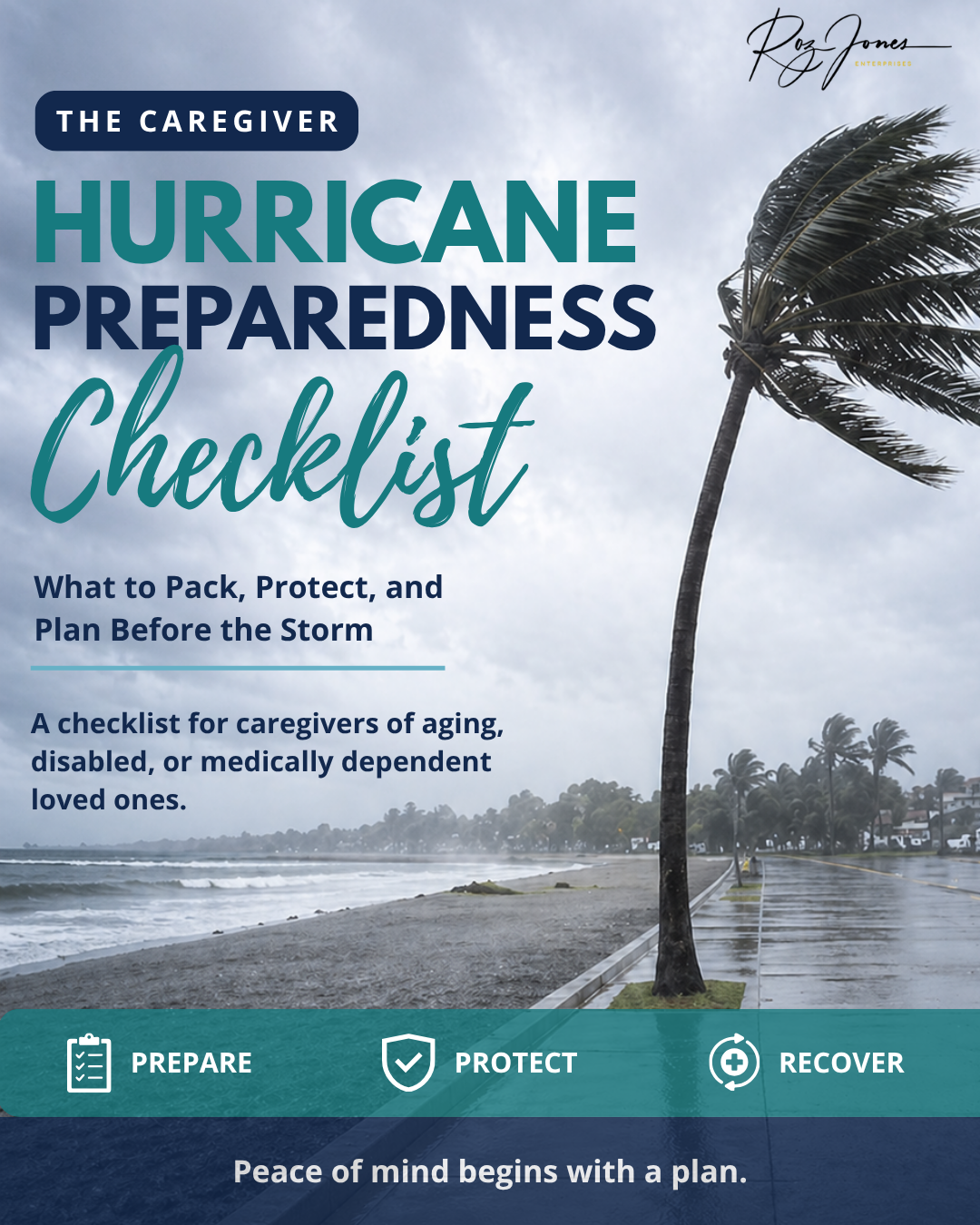
I created the Caregiver Hurricane Preparedness Checklist to help caregivers get organized before the storm is in the forecast. It is a simple, practical resource to help you think through what your aging loved one may need, what documents should be easy to access, what supplies should be ready, and what conversations need to happen before an emergency.
Purchase the Caregiver Hurricane Preparedness Checklist for $1.99 and take one small but important step toward protecting your loved one — and your peace of mind — this hurricane season.
Use Technology, But Do Not Let It Run You
Digital tools can help caregivers stay organized. Medication reminders, shared calendars, health portals, emergency contact lists, and document storage can make a big difference.
But too many apps, alerts, messages, and logins can also become another source of stress.
Keep it simple.
Choose one place for appointments.
Choose one place for medication information.
Choose one place for emergency contacts.
Choose one place for important documents.
The goal is not to have every tool. The goal is to have a system that actually supports you.
Create a Small Support Circle
You do not need a crowd. You need reliable people.
Think about who can help with specific things:
Who can sit with your loved one for an hour?
Who can pick up groceries?
Who can make a phone call?
Who can help organize paperwork?
Who can listen without judging?
Who can step in during an emergency?
Be specific when you ask for help. People often say, “Let me know if you need anything,” but they may not know what to do until you give them a clear task.
And let me be clear: asking for help does not make you less capable. It makes the care more sustainable.
Make Room for Professional Support
Sometimes your friends and family cannot hold everything you are carrying.
That is where therapy, coaching, support groups, or caregiver counseling can help. You deserve a space where the conversation is not only about your loved one’s needs, but about yours too.
You need a place to say the hard things.
The things you feel guilty admitting.
The things you are tired of carrying.
The things you do not want to say in the family group chat.
Professional support can help you process the grief, pressure, anger, fear, and fatigue that caregiving can bring.
And sometimes, you do not just need emotional support. You need a plan.
You need someone to help you look at the full picture: the care responsibilities, the family dynamics, the emergency needs, the documents, the daily routines, and the decisions that keep getting pushed down the road.
That is where a Family Care Planning Session with Roz Jones can help.
In a family care planning session, we can talk through what is happening, what needs to be organized, where support is missing, and what next steps may help you care with more clarity and less chaos.
Book a Family Care Planning Session with Roz Jones today and get support building a care plan that includes your aging loved one — and you.
Let Respite Be Part of the Plan
Respite is not abandonment.
It is not selfish.
It is not a luxury.
It is not something you only deserve when everything is falling apart.
Respite gives you space to breathe, reset, and remember that you are still a person outside of caregiving.
Whether it is a few hours, a full day, or planned support during the week, respite needs to be discussed before the crisis hits.
You Are Allowed to Have a Life Too
One of the hardest parts of caregiving is how quietly your own life can shrink.
You stop making plans.
You stop resting well.
You stop dreaming out loud.
You stop doing things that bring you joy because there is always something else that needs to be done.
But caregiving should not require you to disappear.
You are allowed to laugh.
You are allowed to go out.
You are allowed to rest.
You are allowed to want support.
You are allowed to have boundaries.
You are allowed to still be you.
Your aging loved one matters.
And so do you.
A Gentle Reminder for the Caregiver
You do not have to wait until you are at your breaking point to make a change.
Start small.
Choose one thing this week that supports your emotional well-being. Not ten things. Not a complete life overhaul. Just one.
Make the phone call.
Ask for help.
Take the break.
Organize the paperwork.
Say the boundary out loud.
Schedule the appointment.
Give yourself permission to breathe.
Caregiving takes strength. But real strength is not carrying everything alone.
It is knowing when to pause.
It is telling the truth about what you need.
It is preparing before the crisis.
It is asking for support before you are running on fumes.
If you have not read the first part of this conversation, take a moment to revisit Breaking the Stigma: Addressing Mental Health in Caregiving. It is an important reminder that your mental health is not separate from the care plan.
It is part of it.
Join the Moments of Grace Launch List

Caregiving asks a lot of you — emotionally, physically, mentally, and spiritually. That is why Roz Jones created Moments of Grace: A 40-Day Caregiver Prayer Journal, a faith-filled journal designed to help caregivers pause, reflect, release, and reconnect with God in the middle of the caregiving journey.
Through daily prayers, comforting scriptures, guided journal prompts, and uplifting affirmations, Moments of Grace offers caregivers a quiet place to be honest about what they are carrying while receiving encouragement for the road ahead.
Whether you are caring for an aging parent, spouse, loved one, patient, or family member, this journal is a reminder that your spirit needs care too.
Need Help Getting a Plan in Place?
Caregivers, please do not wait until you are exhausted, overwhelmed, or in the middle of an emergency to get organized.
Preparation is not panic.
Preparation is care.
That is why I created the Caregiver Hurricane Preparedness Checklist.
For only $1.99, this checklist helps caregivers organize important details before an emergency happens, including medications, emergency contacts, documents, supplies, evacuation needs, and care information.
Purchase the Caregiver Hurricane Preparedness Checklist for $1.99 today and give yourself one less thing to carry from memory.
When You Can’t Do it All Give Roz a Call!

If your caregiving situation feels bigger than a checklist, I invite you to book a Family Care Planning Session with me.
Together, we can talk through what needs to be organized, what responsibilities need to be shared, and what support needs to be put in place so you are not holding everything alone.
Let’s create a care plan that protects your loved one and supports you too.
Subscribe to The Caregiver Cafe Weekly Newsletter!

1. YOU ARE NOT ALONE: The problems you face as a caregiver are experienced by other caregivers. Knowing that you’re not alone can be comforting.
2. Tools and Resources: Find caregiver stress management tools and gain perspective from other caregiver’s experiences.
3. LEARN TO: Ask for help, accept help when it is offered, and acknowledge yourself on this caregiving journey. Hear from experts on how to balance caregiving responsibilities by taking care of your needs and involving others to help manage the natural stress and isolation of being a caregiver.

