By Roz Jones
Caring for a former spouse is not the kind of caregiving situation most people prepare for.
You may have thought that chapter of your life was closed. You may have gone through the divorce, divided the household, rebuilt your routines, created distance, and learned how to live without being responsible for that person every day.
Then illness, aging, disability, surgery, memory changes, or a medical crisis enters the picture.
And suddenly, here you are again.
Answering calls.
Checking in.
Taking them to appointments.
Helping with meals.
Listening to their fears.
Trying to make sure they are safe.
Trying to do the right thing without getting pulled back into everything you worked so hard to heal from.
In my previous blog, Navigating Boundaries When Caregiving for a Former Spouse, I talked about defining your caregiving role, setting communication boundaries, making time for yourself, seeking support, and considering legal and financial boundaries.
Now I want to go a little deeper.
Because sometimes the hardest boundaries are not the ones written on paper.
Sometimes the hardest boundaries are the ones you have to keep in your heart.
You Can Care Without Returning to the Relationship
Let’s start there.
Providing care does not mean you are stepping back into the marriage.
It does not mean you are available the way you used to be.
It does not mean you are responsible for their loneliness.
It does not mean you have to comfort every fear.
It does not mean you have to explain yourself to everyone who has an opinion.
It does not mean the old relationship gets to come back just because care is needed.
Caregiving can blur the line between compassion and emotional re-entry.
You may start by helping with one thing, and before you know it, you are being treated like the spouse again. You are the first call, the emotional support, the problem-solver, the scheduler, the reminder, the listener, and the one expected to make everything okay.
Caregiver, let me say this clearly:
You can be kind without becoming consumed.
You can help without going backward.
You can care without reopening a door that needed to stay closed.
Watch for Old Patterns Trying to Come Back
Every relationship has patterns.
Maybe you were always the fixer.
Maybe you were always the one who stayed calm.
Maybe you were the one who made the appointments, handled the bills, smoothed things over with the children, or carried the emotional weight of the household.
Now caregiving can make those old roles show up again.
You may find yourself doing too much before anyone asks. You may feel guilty for saying no. You may feel like if you do not step in, everything will fall apart. You may feel responsible for their comfort, their choices, their emotions, or their relationship with other family members.
That is where you have to pause.
Ask yourself:
Am I helping because this is truly needed?
Or am I falling back into an old role?
Am I responding from compassion?
Or am I responding from guilt?
Am I making a choice?
Or am I feeling pressured?
Am I supporting their care?
Or am I becoming responsible for their whole life again?
Those are honest questions.
And honest questions can save you from silent resentment.
Guilt Is Not a Care Plan
Guilt can be loud in this kind of caregiving situation.
You may feel guilty because you left.
Guilty because the marriage ended.
Guilty because they are sick.
Guilty because they do not have enough support.
Guilty because the children are watching.
Guilty because you still care, but you cannot give everything.
But guilt is not a good leader.
Guilt will tell you to say yes when your body is tired.
Guilt will tell you to answer the phone when you need peace.
Guilt will tell you to ignore your current life.
Guilt will tell you that having limits makes you wrong.
It does not.
A boundary made from wisdom is not cruelty.
A no spoken with honesty is not abandonment.
You are allowed to make caregiving decisions from a grounded place, not from guilt.
Try saying:
“I care about your well-being, but I need to be honest about what I can do.”
“I am not able to be available every day.”
“I can help with this specific need, but I cannot take on everything.”
“I need other people involved so this does not fall only on me.”
That is not harsh.
That is clear.
Do Not Let Caregiving Become Emotional Debt
Sometimes former spouses have unfinished emotional business.
There may be apologies that never came.
There may be wounds that were never acknowledged.
There may be years of being misunderstood, dismissed, betrayed, disappointed, or overextended.
Then caregiving begins, and suddenly you are expected to show up with tenderness, patience, and grace.
That can be complicated.
You may want to help because it is the right thing to do, but still feel anger about the past. You may feel compassion one day and resentment the next. You may feel sad for them while also remembering what they put you through.
That does not make you a bad caregiver.
It makes you human.
But you have to be careful not to pay emotional debt that was never yours to pay.
Caregiving should not require you to pretend the past did not happen.
You do not have to be cruel.
You do not have to bring up old arguments.
You do not have to punish them.
But you also do not have to erase your own experience in order to provide care.
Sometimes the boundary is simply this:
“I can help with your care needs, but I am not available to revisit or repair the entire relationship.”
That is a valid boundary.
Protect Your Current Relationships and Household
If you have a current partner, children, grandchildren, family members, or others who depend on you, caregiving for a former spouse may affect them too.
This is something caregivers do not always talk about.
Your current partner may feel unsure about how much emotional energy is going toward your former spouse. Your children may have mixed feelings. Your household may feel the stress of your time, attention, and availability being stretched.
That does not mean you should not help.
It means you need to be honest about the impact.
Before you keep saying yes, ask:
Is this caregiving role creating tension in my current home?
Am I emotionally unavailable to the people in my life now?
Am I hiding how much I am doing?
Am I giving more than I can explain peacefully?
Is my current life being organized around my former spouse’s needs?
Caregiving is important.
But your current life matters too.
Do not sacrifice the relationships you are living in now to maintain a role from the past.
Keep the Conversations Focused on Care
When emotions run high, conversations can drift.
A call about medication becomes a conversation about the divorce.
A ride to the doctor becomes a discussion about what went wrong.
A check-in becomes a request for emotional closeness.
A family update becomes a replay of old wounds.
This is where you need conversational boundaries.
You can keep the focus on care without being cold.
You might say:
“I want to stay focused on what you need for the appointment.”
“I am not going to discuss the past right now.”
“I hear that you are feeling emotional, but I am not the best person to process that with.”
“I want to help with your care, but I need our conversations to stay respectful.”
“We can talk about the next step, but I am not available for an argument.”
Sometimes the most loving thing you can do is refuse to let every conversation become emotionally unsafe.
Know the Signs That It Is Becoming Too Much
Caregiving can become unhealthy when it starts taking more from you than you can recover from.
Pay attention to the signs.
You feel anxious when their name appears on your phone.
You feel responsible for their mood.
You feel pulled back into old relationship dynamics.
You are hiding the amount of care you are giving.
You are neglecting your own health, rest, work, or relationships.
You feel resentful but keep saying yes.
You feel like you cannot stop because everyone expects you to continue.
You are constantly explaining, defending, or justifying your boundaries.
Caregiver, those signs matter.
Your body may tell you the truth before your mouth is ready to say it.
If caregiving starts costing you your peace, your sleep, your emotional stability, or your current relationships, it is time to reassess the arrangement.
Not because you do not care.
Because care needs to be sustainable.
Let Other People Be Responsible Too
One of the quiet traps in caregiving is believing that because you can do something, you must do it.
No.
Just because you are capable does not mean you are the only option.
Other relatives, adult children, community resources, paid caregivers, case managers, neighbors, church members, or professional services may need to be part of the support system.
You are allowed to say:
“I cannot be the only person in this role.”
“We need to divide responsibilities.”
“This requires more support than I can provide.”
“I am willing to help, but I need backup.”
“I need us to identify who else can step in.”
Do not let other people’s absence become your full-time assignment.
Give Yourself Permission to Feel More Than One Thing
This type of caregiving is emotionally layered.
You can care about your former spouse and still feel tired.
You can have compassion and still need distance.
You can remember the good and still honor why the relationship ended.
You can want them safe and still not want to be pulled back in.
You can help and still wish the situation were different.
All of that can be true at the same time.
You do not have to make your feelings neat for other people to understand.
You just need to be honest with yourself.
Caregiving for a former spouse requires more than a kind heart.
It requires emotional honesty.
It requires you to notice when old patterns are returning. It requires you to separate compassion from obligation. It requires you to protect your current life while still making thoughtful choices about care.
You are allowed to support someone without becoming who you used to be to them.
You are allowed to care without carrying everything.
You are allowed to have boundaries that protect your peace.
And caregiver, please remember this:
Helping should not hurt you so deeply that you lose yourself in the process.
If it is starting to hurt, that does not mean you have failed.
It means something needs to change.
Purchase Moments of Grace

When caregiving comes with history, emotions can be heavy.
You may find yourself carrying guilt, grief, frustration, compassion, exhaustion, and responsibility all at the same time. That is a lot for one heart to hold.
That is why I created Moments of Grace: A Caregiver’s Guided Journal for Reflection, Prayer, and Peace.
This journal was made for caregivers who need a quiet place to breathe, reflect, release what they are carrying, and reconnect with themselves in the middle of the caregiving journey.
If you are caring for a former spouse, an aging parent, a loved one, or someone whose needs are stretching you emotionally, this journal can help you slow down and remember that your feelings matter too.
Purchase Moments of Grace today and give yourself permission to pause, reflect, and receive a little grace along the
Prepare Before the Emergency Comes
Emotional boundaries matter.
But practical preparation matters too.
If you are caring for an aging loved one, a former spouse, or someone with changing health needs, it is important to know where the essentials are before an emergency happens.
Medication lists.
Emergency contacts.
Important documents.
Evacuation details.
Medical equipment needs.
Insurance information.
Care instructions.
These are not things you want to search for during a storm, power outage, hospitalization, or sudden crisis.
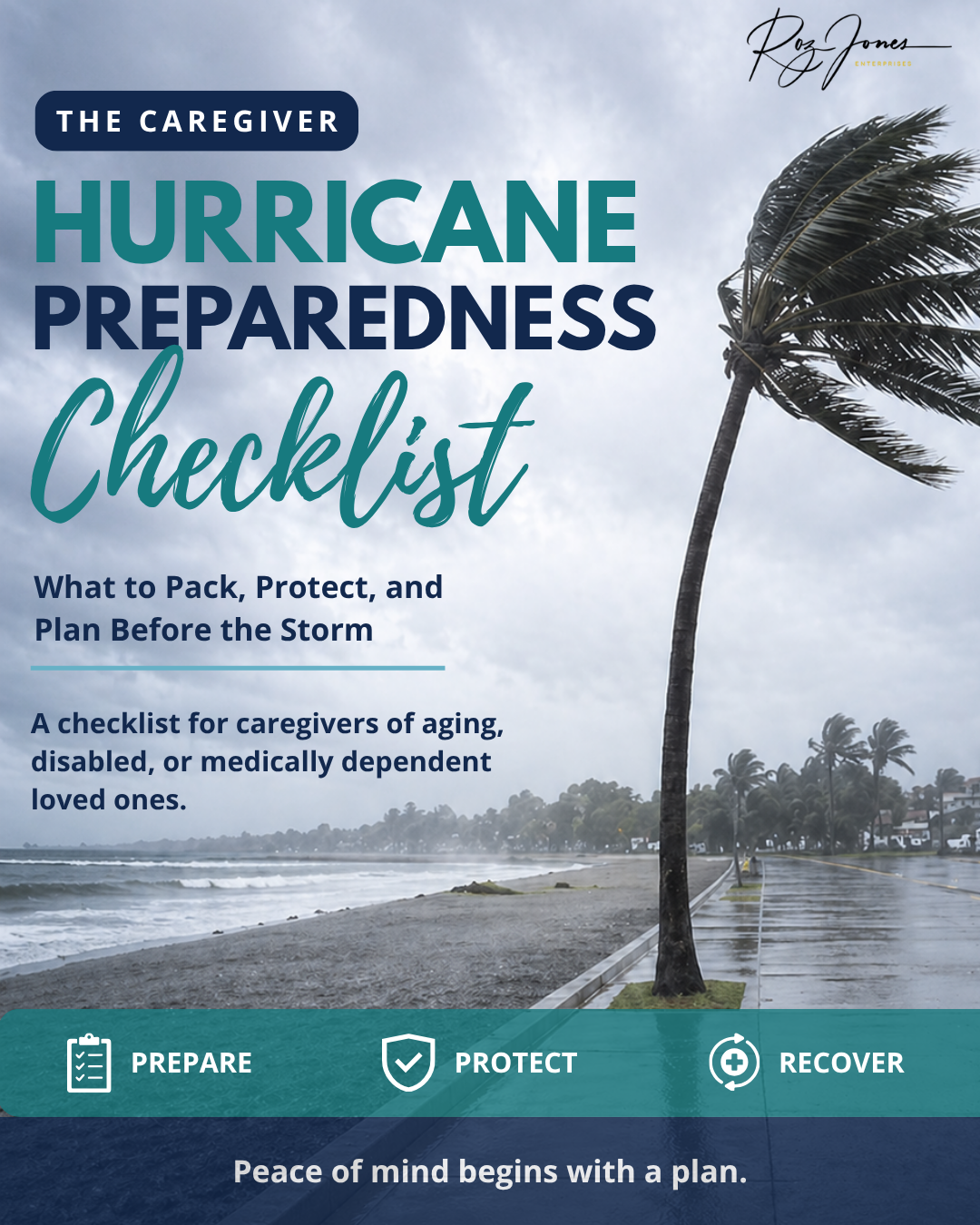
The Caregiver Hurricane Preparedness Checklist was created to help caregivers organize the details that matter before they are needed.
For only $1.99, this checklist gives you a simple place to start so you can feel more prepared, less scattered, and more confident when unexpected situations arise.
Purchase the Caregiver Hurricane Preparedness Checklist for $1.99 today and take one more step toward protecting your loved one before an emergency.
Need Help Sorting Through the Care Plan?

If you are caring for a former spouse, aging loved one, or family member and the boundaries are starting to feel complicated, you do not have to figure it out alone.
Book a Family Care Planning Session with Roz Jones and get support creating a caregiving plan that is clear, compassionate, and realistic.
Together, we can talk through what is working, what is becoming too heavy, and what boundaries need to be strengthened so you can continue to care without losing yourself in the process.
Subscribe to The Caregiver Cafe Weekly Newsletter!

1. YOU ARE NOT ALONE: The problems you face as a caregiver are experienced by other caregivers. Knowing that you’re not alone can be comforting.
2. Tools and Resources: Find caregiver stress management tools and gain perspective from other caregiver’s experiences.
3. LEARN TO: Ask for help, accept help when it is offered, and acknowledge yourself on this caregiving journey. Hear from experts on how to balance caregiving responsibilities by taking care of your needs and involving others to help manage the natural stress and isolation of being a caregiver.