Protect the Paperwork Before the Storm

By Roz Jones

When we talk about disaster preparedness, most people think about bottled water, batteries, flashlights, canned goods, medications, and evacuation bags.

And yes, all of that matters.

But caregivers, there is another part of preparedness that often gets overlooked until it is too late: the documents, passwords, records, and digital information that help you care for your aging loved one when life gets disrupted.

Because after a storm, flood, power outage, evacuation, or medical emergency, you may need quick access to information like insurance cards, medication lists, medical records, banking contacts, advance directives, prescriptions, home insurance, or power of attorney documents.

And if all of that is sitting in one folder, on one phone, in one drawer, or on one computer that gets damaged, lost, or locked, that can create a whole new crisis on top of the one you are already managing.

So today, we are talking about how caregivers can back up and safely store important information before disaster strikes.

Why Data Backup Matters for Caregivers

Caregivers carry a lot of invisible responsibility.

You may be the one keeping up with appointment notes, prescription refills, insurance information, doctors’ names, pharmacy contacts, health history, bills, passwords, home care information, and emergency contacts.

That information matters every day, but it becomes even more important during hurricane season or any emergency.

  • If you have to evacuate quickly, can you access your loved one’s medication list?
  • If their wallet gets misplaced, do you have copies of their ID and insurance cards?
  • If the power is out, can you still reach the pharmacy or oxygen provider?
  • If your phone breaks, does someone else know where the documents are?
  • If your loved one is hospitalized, can you pull up the paperwork that allows you to help make decisions?

These are the questions caregivers need to answer before the emergency.

Start With a Caregiver Document Checklist

Before choosing a storage system, first decide what needs to be saved.

Start with the documents and information that would be hardest to replace during an emergency.

That may include:

  • Photo ID
  • Insurance cards
  • Medicare or Medicaid cards
  • Medication list
  • Medical history
  • Doctor and pharmacy contacts
  • Emergency contacts
  • Advance directives
  • Power of attorney documents
  • Living will
  • Home insurance or rental documents
  • Banking and financial contact information
  • Utility account information
  • Medical equipment provider information
  • Veteran benefit information, if applicable
  • Facility or home care agency contacts
  • Recent care notes or discharge instructions

Keep the list simple enough that you will actually use it.

The goal is not to create a perfect filing system. The goal is to make sure the right information is available when it is needed.

Use the 3-2-1 Backup Rule

Caregivers, one copy is not enough.

If something is important, it should not live in only one place.

A simple backup method many experts recommend is the 3-2-1 backup rule. That means keeping three copies of important files, using two different types of storage, with one copy stored off-site or away from the original location. CISA and other backup guidance use this approach as a way to reduce the risk of losing critical data during disasters, device failures, or cyber incidents.

For caregivers, that might look like this:

One printed copy in a waterproof folder
One digital copy stored securely in the cloud
One backup copy on an external hard drive or secure digital vault

This way, if one copy is damaged, lost, or unavailable, you still have another way to access what you need.

Cloud Storage Can Be Helpful If You Secure It

Cloud storage can be a practical option for caregivers because it lets you access documents from different devices and locations.

Options may include Google Drive, Dropbox, iCloud, OneDrive, or another secure document storage system.

This can be helpful when you need to pull up a medication list at the doctor’s office, share a document with a sibling, or access insurance information during an evacuation.

But convenience should not come at the expense of safety.

If you use cloud storage, make sure you:

  • Use a strong, unique password
  • Turn on multi-factor authentication
  • Limit who has access
  • Organize files clearly
  • Avoid sharing sensitive documents through unsecured links
  • Review access permissions regularly
  • Remove access for anyone who no longer needs it

The FTC recommends using strong passwords and two-factor authentication to help protect online accounts that may contain personal information.

So yes, use the tools. But use them wisely.

Consider a Digital Vault for Sensitive Information

Some caregivers may benefit from using a digital vault.

A digital vault is a secure online place where you can store important documents, passwords, account information, and instructions for trusted people who may need access in the future.

This can be helpful if you are managing documents for an aging loved one and want everything organized in one secure location.

AARP notes that digital vaults can help organize important documents that may otherwise be scattered across physical files, email inboxes, cloud accounts, and online storage platforms.

This can be especially useful for:

  • Advance directives
  • Insurance documents
  • Financial records
  • Legal paperwork
  • Account information
  • Funeral or end-of-life wishes
  • Medical care instructions
  • Property documents

If you choose this option, make sure the platform is reputable, secure, and easy enough for your family to understand. The fanciest system is not always the best system. The best system is the one your caregiver team can actually use.

External Hard Drives and USB Drives Still Have a Place

Not everything has to be online.

External hard drives and password-protected USB drives can still be useful backup options, especially if you want a physical copy of important digital files.

But they need to be handled carefully.

If you use an external drive or USB drive:

  • Password-protect it
  • Store it in a waterproof container
  • Keep it in a safe place
  • Label it clearly without exposing sensitive information
  • Update it regularly
  • Do not make it the only backup
  • Keep one copy outside the home, if possible

USB drives can be lost, damaged, or stolen. External drives can fail. That is why they should be part of the plan, not the whole plan.

Use a Password Manager Instead of a Password List

Caregivers often end up managing passwords for portals, pharmacies, insurance accounts, utility accounts, banking, email, medical apps, and patient platforms.

Writing every password on a loose piece of paper or saving them in a document called “passwords” is risky.

A password manager can help store and organize passwords securely. It can also help create stronger passwords instead of using the same password over and over.

Also, make sure there is a plan for trusted access.

If something happens to you, who can access the information needed to care for your loved one?
If something happens to your loved one, who has legal authority to manage accounts or documents?
If the person with all the passwords is unavailable, what happens next?

These are not always easy conversations, but they are necessary ones.

Protect Medical and Financial Information

Caregivers often handle sensitive information, so privacy matters.

Be careful about where and how you store:

  • Social Security numbers
  • Bank account information
  • Insurance records
  • Medical records
  • Legal documents
  • Passwords
  • Tax documents
  • Health portal logins

Do not text sensitive documents casually.
Do not email private information without thinking it through.
Do not share login information with people who do not need access.
Do not leave printed copies sitting out in plain view.

And when you do share information, share only what is necessary.

Caregiving requires coordination, but coordination should still protect your loved one’s dignity and privacy.

Make the Information Easy to Find in an Emergency

A backup system only works if people know how to use it.

Create a simple emergency document guide that says:

  • Where the printed folder is located
  • Where the digital copies are stored
  • Who has access
  • Who the backup caregiver is
  • Where passwords or vault access instructions are kept
  • Which documents are most important in an emergency
  • Who to call first

Do not make people search through ten folders, three inboxes, and five devices while the power is out.

Keep it simple.
Keep it organized.
Keep it updated.

That is the part that saves time when emotions are high.

Review and Update Everything Regularly

Your backup plan should not be something you create once and forget.

Review it at least twice a year, and definitely before hurricane season if your loved one lives in Florida or another storm-prone area.

Also check that your backup files actually open.

That part matters.

A backup you cannot access is not really a backup.

If you have not read the previous blog, Data Backup and Storage Solutions for Caregiver, start there.

That blog walks through practical ways caregivers can protect an aging loved one’s important information, including cloud storage, external hard drives, password-protected USB drives, online backup services, and backup recovery tools.

Once you have those digital backup systems in place, this blog helps you take the next step: making sure those documents, passwords, emergency contacts, and care records are easy to access when hurricane season, power outages, evacuations, or medical emergencies happen.

Need help turning this into a real plan?

Photo by Connor Scott McManus on Pexels.com

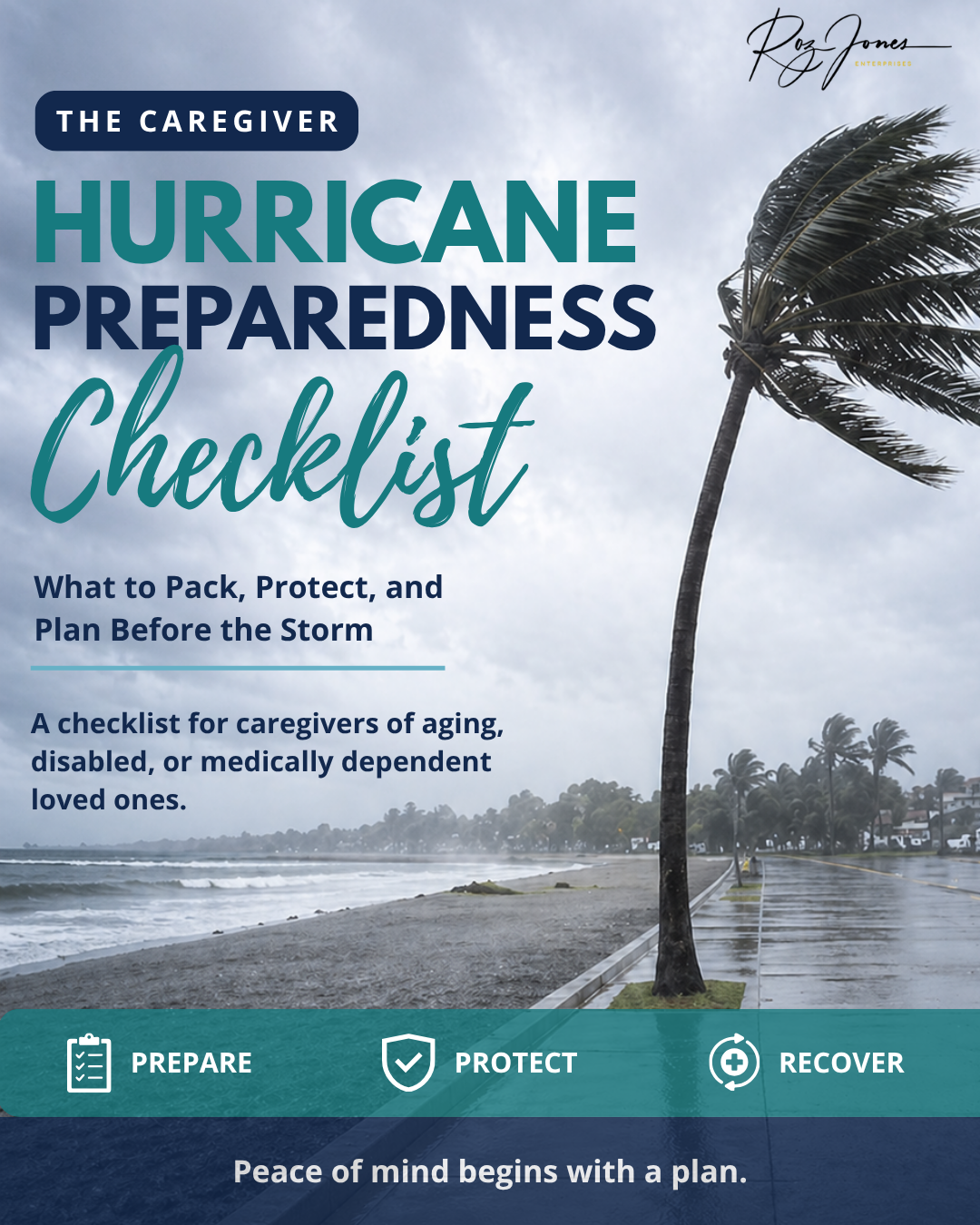
Reading about hurricane preparations is a good first step. But caregivers also need something they can print, fill out, and keep close when the pressure is on. Roz is creating a printable Caregiver Hurricane Preparedness Checklist to help families prepare with more clarity and less last-minute panic.

This front-and-back checklist will include space for emergency contacts, medical information, supply reminders, care bag items, and recovery steps. Want first access when it is ready? Complete the interest form below.

← Back

Thank you for your response. ✨

Are you currently caring for an aging loved one?

When You Can’t Do it All Give Roz a Call!

Roz Jones is a dedicated caretaker turned CEO with over a decade of experience in helping families care for and make decisions for loved ones and their legacies.Roz is a compassionate, innovative healthcare industry leader.

If your family needs support talking through care decisions, roles, and next steps, book a family care planning session with Roz Jones to create more clarity before a crisis forces rushed decisions.

Subscribe to The Caregiver Cafe Weekly Newsletter!

Caregiving can be a roller coaster of ups and downs. The information that you will receive from The Caregiver Cafe Weekly Specials Newsletter will support you as a caregiver. Remember…

1. YOU ARE NOT ALONE: The problems you face as a caregiver are experienced by other caregivers. Knowing that you’re not alone can be comforting. 

2. Tools and Resources:  Find caregiver stress management tools and gain perspective from other caregiver’s experiences.

3. LEARN TO: Ask for help, accept help when it is offered, and acknowledge yourself on this caregiving journey. Hear from experts on how to balance caregiving responsibilities by taking care of your needs and involving others to help manage the natural stress and isolation of being a caregiver. 

Florida Hurricane Resources Every Caregiver Should Know

By Roz Jones

Preparing for hurricane season can feel overwhelming, especially when you are caring for an aging loved one. There are supplies to gather, medications to track, documents to protect, phone numbers to update, and decisions to make before the storm is anywhere near the forecast.

And caregivers, I want you to hear me clearly: you do not have to figure it all out at the last minute.

The goal is not to panic.
The goal is to prepare.

When you know where to turn for information, support, alerts, and local resources, you give yourself and your loved one a stronger foundation before hurricane season gets active.

Because preparation is not just what you pack.
Preparation is also knowing who to call, where to go, what to ask, and how to keep your loved one included in the plan.

Florida Hurricane Season Is the Time to Prepare Early

Florida hurricane season runs from June 1 through November 30, but caregivers should not wait until a storm is already forming to get ready.

If your aging loved one lives in Florida, now is the time to review their emergency plan, update contact information, check medication refills, confirm transportation options, and learn what resources are available in their county.

This is especially important because not every older adult can simply “grab a bag and go.”

Some need help getting out of the home.
Some rely on oxygen or other medical equipment.
Some need refrigerated medication.
Some have mobility challenges.
Some may become confused, anxious, or overwhelmed when routines change.

That is why hurricane preparedness for caregivers must be personal. It has to match your loved one’s real life, not just a general checklist.

Start With FloridaDisaster.org

If you are caring for an aging loved one in Florida, FloridaDisaster.org should be one of your first stops.

This site provides statewide emergency preparedness information, planning tools, county emergency management contacts, evacuation guidance, and resources for people with access and functional needs.

Use this resource to:

  • Find your loved one’s local county emergency management office
  • Review hurricane preparedness guidance
  • Check evacuation and shelter information
  • Learn about planning for special needs
  • Create or update a family emergency plan

This is especially helpful if your loved one lives alone or if you are caregiving from another city or state. You need to know which county office to contact and what local support may be available before there is an active storm.

Know the Florida Special Needs Registry

This one is important.

If your aging loved one has medical needs, mobility challenges, relies on electricity for medical equipment, or may need help during evacuation or sheltering, look into the Florida Special Needs Registry.

This registry helps connect individuals with special needs to their local emergency management agency so emergency planners have information that may help them prepare and respond during a disaster.

But caregiver, please understand this clearly: registration does not mean every detail is automatically handled.

After registering, follow up with the local county emergency management office. Ask what happens next. Ask what your loved one should bring. Ask whether transportation assistance is available. Ask whether a caregiver can come with them. Ask what kind of medical support the shelter can and cannot provide.

That follow-up matters.

Do not just register and assume everything is finished. Make the call. Get the details. Write them down.

Contact the Local County Emergency Management Office

Florida is one state, but hurricane preparation is local.

What happens in one county may not look the same in another. Evacuation zones, shelter openings, transportation support, alert systems, and local updates are often handled at the county level.

Your loved one’s county emergency management office can help you understand:

  • Evacuation zones
  • Shelter locations
  • Special needs shelter registration
  • Transportation assistance
  • Local emergency alerts
  • Pet-friendly shelter options
  • Road closure updates
  • County-specific hurricane guidance

This is the information you want before the storm is approaching, not when everyone else is trying to get through on the phone.

Caregiving requires details. During hurricane season, those details can make all the difference.

Sign Up for Emergency Alerts

A caregiver should not have to depend on social media rumors or last-minute family messages to know what is happening.

Sign up for local emergency alerts in the county where your loved one lives. Many Florida counties offer phone, text, or email alerts for weather warnings, evacuation orders, shelter openings, boil water notices, road closures, and other urgent updates.

Also make sure your aging loved one has more than one way to receive information.

That may include:

  • A charged cell phone
  • A written list of emergency contacts
  • A battery-powered radio
  • A weather radio
  • A trusted neighbor
  • A family communication chain
  • Local news access

And remember, if your loved one has hearing, vision, memory, or mobility challenges, the alert system needs to match their actual ability to receive and respond to information.

An alert only helps if they can hear it, read it, understand it, or have someone nearby who can help them act on it.

Use Ready.gov for the Basics

Ready.gov is a helpful resource for general disaster preparedness, including emergency kits, communication plans, and family readiness.

This can be a good starting point if you are building your hurricane plan from scratch.

But caregiver, do not stop at the general checklist.

Use the basic emergency kit as your foundation, then personalize it for your loved one’s care needs.

Ask yourself:

Do they need medication at a certain time?
Do they need supplies for incontinence care?
Do they have dietary restrictions?
Do they need glasses, hearing aids, dentures, or mobility equipment?
Do they use medical equipment that requires electricity?
Do they become confused or anxious when routines change?
Do they need documents that allow someone else to speak on their behalf?

A basic checklist is helpful. A personalized checklist is safer.

The American Red Cross Can Help With Emergency Readiness

The American Red Cross offers disaster preparedness information, shelter guidance, first aid resources, and support during and after disasters.

For caregivers, the Red Cross can be especially helpful when thinking through emergency supplies, basic first aid, sheltering, family communication, and preparedness for older adults.

The Red Cross also reminds families to consider assistive devices, prescriptions, medical equipment, and support networks when preparing older adults for emergencies.

That support network piece is important.

Caregiver, you should not be the only person who knows the plan.

Someone else should know where the documents are.
Someone else should know the medication list.
Someone else should know who to call.
Someone else should know where your loved one would go if evacuation is needed.

Check With the Florida Department of Health

The Florida Department of Health works with county health departments and local emergency management agencies around emergency preparedness, including special needs shelter planning.

If your loved one may need a special needs shelter, contact the county early to ask about registration, eligibility, transportation, caregiver access, and what supplies your loved one needs to bring.

Ask questions like:

  • Does my loved one qualify for a special needs shelter?
  • How do we register?
  • What happens after registration?
  • Can a caregiver stay with them?
  • Are pets allowed?
  • What medical support is provided?
  • What medical support is not provided?
  • What should we bring?
  • How will we be notified if evacuation is recommended?

Special needs shelters are a resource, but they are not a full replacement for a care plan.

So ask the questions now, while there is still time to prepare.

Do Not Forget the Florida Department of Elder Affairs

The Florida Department of Elder Affairs is another helpful resource for older adults, caregivers, and families preparing for hurricane season.

Through elder-focused programs and local aging resources, caregivers may be able to find information about disaster planning, transportation, local support, and services for older adults.

If you are not sure where to begin, look into your local Area Agency on Aging or Florida’s Elder Helpline. These resources can help connect caregivers and older adults with local support before and after a disaster.

This can be especially helpful if your loved one lives alone, has limited family nearby, or needs help navigating services.

Review Nursing Home or Assisted Living Plans

If your aging loved one lives in an assisted living facility, nursing home, independent senior community, or another residential care setting, do not assume the facility has everything handled.

Ask for the emergency plan.

Ask:

  • Will the facility evacuate or shelter in place?
  • Where will residents be taken if evacuation is needed?
  • How will families be notified?
  • How are medications transported?
  • What happens if the power goes out?
  • Is there generator support?
  • How are residents with dementia supported?
  • Who should families contact during and after the storm?
  • How often will updates be provided?

When you are caregiving, questions are part of the job.

Build Your Own Caregiver Resource List

Once you gather resources, put them all in one place.

Create a printed and digital list with:

  • County emergency management office
  • Local emergency alert sign-up
  • Special Needs Registry information
  • Nearest hospital
  • Primary doctor
  • Pharmacy
  • Home health agency
  • Oxygen or medical equipment provider
  • Insurance contact
  • Utility company
  • Transportation contact
  • Trusted neighbors
  • Family contacts
  • Facility contact, if applicable

Keep one copy with you.
Keep one copy with your loved one.
Share one copy with a trusted backup caregiver.

And please make sure the print is large enough for your loved one to read.

If you have not read the first blog, Resources for Disaster Preparedness and Planning, start there.

That blog shares helpful emergency preparedness resources, including Ready.gov, FEMA, the American Red Cross, CDC, Elder Care Locator, AARP, state and local emergency management agencies, emergency alert systems, and community emergency response teams.

Once you have reviewed those general disaster preparedness resources, use this Florida-focused hurricane guide to take the next step: confirming local support, checking evacuation information, signing up for alerts, and making sure your aging loved one is prepared before hurricane season becomes active.

Need help turning this into a real plan?

Photo by Connor Scott McManus on Pexels.com

Reading about hurricane preparations is a good first step. But caregivers also need something they can print, fill out, and keep close when the pressure is on. Roz is creating a printable Caregiver Hurricane Preparedness Checklist to help families prepare with more clarity and less last-minute panic.

This front-and-back checklist will include space for emergency contacts, medical information, supply reminders, care bag items, and recovery steps. Want first access when it is ready? Complete the interest form below.

← Back

Thank you for your response. ✨

Are you currently caring for an aging loved one?

When You Can’t Do it All Give Roz a Call!

Roz Jones is a dedicated caretaker turned CEO with over a decade of experience in helping families care for and make decisions for loved ones and their legacies.Roz is a compassionate, innovative healthcare industry leader.

If your family needs support talking through care decisions, roles, and next steps, book a family care planning session with Roz Jones to create more clarity before a crisis forces rushed decisions.

Subscribe to The Caregiver Cafe Weekly Newsletter!

Caregiving can be a roller coaster of ups and downs. The information that you will receive from The Caregiver Cafe Weekly Specials Newsletter will support you as a caregiver. Remember…

1. YOU ARE NOT ALONE: The problems you face as a caregiver are experienced by other caregivers. Knowing that you’re not alone can be comforting. 

2. Tools and Resources:  Find caregiver stress management tools and gain perspective from other caregiver’s experiences.

3. LEARN TO: Ask for help, accept help when it is offered, and acknowledge yourself on this caregiving journey. Hear from experts on how to balance caregiving responsibilities by taking care of your needs and involving others to help manage the natural stress and isolation of being a caregiver. 

Hurricane Season Is Coming: Is Your Care Plan Ready?

By Roz Jones

If you’ve been with me for a while, you know I believe in staying ready so you don’t have to get ready. In Part I of this series, we talked about the basics; water, food, medications, documents, and all the essentials your aging loved one needs to stay safe when disaster strikes. If you missed that first blog or would like a refresher, you can read it here

Now, as Florida prepares for hurricane season, it is time to take that checklist a step further. Because hurricane preparation is not just about stocking up on supplies.

It is about knowing your evacuation zone.
It is about having a plan if the power goes out.
It is about making sure medications, mobility needs, oxygen, medical equipment, transportation, and communication are handled before the storm is at your door.

And caregivers, let me say this clearly: preparation is not panic.

Preparation is peace.
Preparation is protection.
Preparation is love with a plan.

Hurricane Season Requires a Different Kind of Readiness

Florida’s hurricane season officially runs from June 1 through November 30, and preparation needs to begin before there is a named storm in the forecast. For caregivers of aging loved ones, this planning has to be even more intentional.

Your loved one may not be able to move quickly. They may depend on refrigerated medication, oxygen, a walker, a wheelchair, a CPAP machine, hearing aids, or daily support. They may also experience confusion, fear, or anxiety when their routine is disrupted.

That means your hurricane plan cannot be general.

It has to be personal.

It has to be built around your loved one’s health, home, body, mobility, and care needs.

Start With “Know Your Zone, Know Your Home”

Before you even pack the emergency bag, find out whether your loved one lives in an evacuation zone.

The Florida Division of Emergency Management reminds residents to “Know Your Zone” and “Know Your Home,” because evacuation decisions depend on where the home is located and how well it can withstand wind, rain, flooding, and storm surge.

If your aging loved one lives in Florida, make sure you know:

What evacuation zone they are in
Whether they live in a flood-prone area
Whether their home can handle strong winds and heavy rain
Where the closest shelter is
Whether they qualify for a special needs shelter
How they would evacuate if you could not get there in time

This is not the kind of information you want to search for when everyone else is already on the road.

Do it now.

Write it down.
Share it with family.
Keep a copy in their emergency folder.

Build the Hurricane Kit Around Their Daily Life

A basic hurricane kit should include water, shelf-stable food, flashlights, batteries, phone chargers, hygiene items, a first aid kit, cash, important documents, and supplies for several days.

But when you are caring for an aging loved one, you need to think beyond the basics.

Ask yourself: What does my loved one use every single day?

Then build the kit from there.

Include:

  • A current medication list
  • At least several days of essential medications, when possible
  • Doctor and pharmacy information
  • Medical insurance cards
  • Copies of ID
  • Hearing aid batteries
  • Extra eyeglasses
  • Denture supplies
  • Incontinence products
  • Mobility aids
  • A backup phone charger
  • A battery-powered radio
  • Blankets or lightweight bedding
  • Shelf-stable foods that match their dietary needs
  • Water for drinking and hygiene
  • Comfort items, such as a family photo, sweater, blanket, or small familiar object

If your loved one uses medical equipment that depends on electricity, this becomes even more important. You need a plan for backup power, charging, relocation, or evacuation.

Do not assume the power will come back quickly.
Do not assume the pharmacy will reopen the next day.
Do not assume roads will be easy to navigate after a storm.

Hope is good. A plan is better.

Make a Medication and Medical Equipment Plan

This is one of the most important parts of hurricane preparation for caregivers.

If your loved one takes daily medication, keep an updated list that includes:

  • Medication name
  • Dosage
  • Time of day it is taken
  • Prescribing doctor
  • Pharmacy contact information
  • Refill dates
  • Allergies
  • Medical conditions

If medication needs refrigeration, ask the doctor or pharmacist what to do during a power outage. If your loved one uses oxygen, dialysis, a CPAP machine, an electric wheelchair, or any other power-dependent medical equipment, call the provider before hurricane season gets active.

Ask questions like:

  • How long does the backup battery last?
  • What should we do if the power is out for more than 24 hours?
  • Can equipment be transported safely?
  • Is there a backup supplier?
  • Should the utility company be notified?
  • Does my loved one need to register for a special needs shelter?

In Florida, special needs shelters may be available for residents who need extra medical support during emergencies, but they usually require advance registration through the county or local emergency management office.

Caregivers, please do not wait until a storm is already forming to figure this out.

Have an Evacuation Plan Before the Order Comes

One of the hardest parts of hurricane season is deciding whether to stay or go.

For caregivers, that decision may involve mobility equipment, medications, pets, oxygen, transportation, dementia-related needs, or the physical ability to safely move your loved one.

That is why the evacuation plan needs to be made early.

Decide:

  • Who will pick up your loved one
  • Where they will go
  • What route they will take
  • What supplies need to go with them
  • Who has access to the house
  • Who has copies of important documents
  • What happens if the primary caregiver cannot get there
  • Whether pets are included in the plan
  • What shelter or family home is safest

And let me be direct: if local officials issue an evacuation order, take it seriously.

Storm surge, flooding, high winds, and blocked roads can create dangerous conditions quickly. A plan made ahead of time can help you move with clarity instead of fear.

Do Not Leave Communication to Chance

During a hurricane, cell service may be unreliable. Phones may die. Internet may go down. Family members may be scattered across different areas.

That is why every caregiver needs a communication plan.

Write down:

  • Primary emergency contact
  • Backup emergency contact
  • Doctor’s phone number
  • Pharmacy phone number
  • Home health agency contact
  • Nearest hospital
  • Neighbors who can check in
  • Family members who should receive updates
  • County emergency management contact information

Make sure your aging loved one has these numbers written in large, readable print. Do not rely only on a cell phone contact list.

Also, make sure at least two trusted people know the plan.

Not just you.

Because caregiver, you are important too. If something happens and you cannot get there right away, someone else needs to know what to do.

Protect the Documents Before the Storm

Hurricanes do not just damage homes. They can scatter paperwork, destroy records, and make it harder to access care or financial support after the storm.

Keep copies of important documents in a waterproof folder or bag.

Include:

  • Photo ID
  • Insurance cards
  • Medicare or Medicaid cards
  • Medication list
  • Medical history
  • Doctor information
  • Advance directives
  • Power of attorney documents
  • Emergency contacts
  • Home insurance or rental documents
  • Banking and financial contact information
  • Veteran benefit information, if applicable

If your loved one has advance directives, make sure the right people know where they are.

And if your family has not had those conversations yet, hurricane season is one more reason to stop putting them off.

Hard conversations are still easier before the crisis.

Plan for the Emotional Side Too

We talk a lot about water, batteries, and evacuation routes.

But caregivers also need to prepare for the emotional side of hurricane season.

Storms can be frightening for aging loved ones, especially if they have experienced past trauma, memory loss, anxiety, or confusion. Loud winds, power outages, changes in routine, and leaving home suddenly can be overwhelming.

So think about comfort, not just safety.

Have familiar items nearby.
Keep routines as steady as possible.
Explain the plan calmly and simply.
Use written reminders if your loved one gets confused.
Keep favorite snacks, music, photos, or blankets close.
Limit constant news exposure if it increases their anxiety.

Sometimes the most loving thing you can say is:

“We have a plan. You are not alone. We are going to take this one step at a time.”

Revisit the Plan Throughout the Season

Hurricane preparation is not something you do once and forget.

Check the kit.
Update the medications.
Refresh the water.
Replace expired food.
Charge backup batteries.
Review evacuation routes.
Update phone numbers.
Make sure documents are still current.

And if your loved one has had a recent hospital stay, new diagnosis, fall, surgery, medication change, or mobility change, update the hurricane plan right away.

The plan should match the person they are today, not who they were last year.

If you have not read the first blog, Creating a Disaster Preparedness Checklist for You and Your Aging Loved One, start there. That blog walks through the basic items every caregiver should consider when preparing for an emergency.

Read the previous blog here.

Once you have that foundation, come back to this blog and build your hurricane-season plan around your loved one’s specific care needs.

When You Can’t Do it All Give Roz a Call!

Roz Jones is a dedicated caretaker turned CEO with over a decade of experience in helping families care for and make decisions for loved ones and their legacies.Roz is a compassionate, innovative healthcare industry leader.

If your family needs support talking through care decisions, roles, and next steps, book a family care planning session with Roz Jones to create more clarity before a crisis forces rushed decisions.

Need help turning this into a real plan?

Photo by Connor Scott McManus on Pexels.com

Reading about hurricane preparations is a good first step. But caregivers also need something they can print, fill out, and keep close when the pressure is on. Roz is creating a printable Caregiver Hurricane Preparedness Checklist to help families prepare with more clarity and less last-minute panic.

This front-and-back checklist will include space for emergency contacts, medical information, supply reminders, care bag items, and recovery steps. Want first access when it is ready? Complete the interest form below.

← Back

Thank you for your response. ✨

Are you currently caring for an aging loved one?

Subscribe to The Caregiver Cafe Weekly Newsletter!

Caregiving can be a roller coaster of ups and downs. The information that you will receive from The Caregiver Cafe Weekly Specials Newsletter will support you as a caregiver. Remember…

1. YOU ARE NOT ALONE: The problems you face as a caregiver are experienced by other caregivers. Knowing that you’re not alone can be comforting. 

2. Tools and Resources:  Find caregiver stress management tools and gain perspective from other caregiver’s experiences.

3. LEARN TO: Ask for help, accept help when it is offered, and acknowledge yourself on this caregiving journey. Hear from experts on how to balance caregiving responsibilities by taking care of your needs and involving others to help manage the natural stress and isolation of being a caregiver. 

When Grandparents Become the Plan

By Roz Jones

Sometimes grandparents expect to be the steady presence in a child’s life.

And sometimes, without much warning, they become the primary caregivers.

That shift can happen because of a family crisis, illness, financial instability, mental health concerns, substance use, incarceration, military deployment, death, or simply because the children need a safer and more stable place to land. However it happens, when grandparents step in to raise grandchildren, they are often carrying far more than people can see. National kinship care resources note that grandparents and other relatives frequently become the first safe option for children when parents cannot care for them, often with little time to prepare.

And when that happens, the conversation cannot stop at “they stepped up.”

We also need to ask:
Who is supporting them now?

Grandparents Raising Grandchildren Need More Than Praise

A lot of grandparents raising grandchildren get called strong, selfless, and loving.

And yes, many of them are all of those things.

But praise is not the same as support.

Many grandfamilies are navigating school enrollment, legal paperwork, health appointments, financial strain, transportation needs, behavior changes, grief, and the physical demands of parenting at a later stage in life. Federal and national kinship-care resources continue to emphasize that kinship caregivers often need help with both child-related and adult-related supports, including access to benefits, legal guidance, and service coordination.

So if you are someone caring for an aging loved one who is now raising grandchildren, or if you are a caregiver trying to support a grandparent in this role, this is important to understand: love may be what brought them into the role, but love alone is not enough to sustain it.

The Hidden Weight of Kinship Care

Grandparents who step into parenting again are often managing two caregiving realities at once.

They may be caring for grandchildren while also dealing with their own aging, chronic health conditions, fatigue, or financial concerns. And caregivers supporting them may find themselves trying to meet the needs of both generations at the same time.

That kind of layered care can wear people down.

The CDC reported in 2024 that caregivers, compared with noncaregivers, experienced worse outcomes on many health indicators, including mental health measures and several chronic physical conditions.

That does not mean grandparents raising grandchildren are not capable. It means they should not be expected to do this without real support.

Practical Support Still Matters

When a grandparent is raising grandchildren, practical help can make a bigger difference than people realize.

That may look like helping with grocery runs, rides to school, after-school pickup, household tasks, meal support, or help organizing medical and school paperwork. Sometimes what keeps a household stable is not one big intervention. It is consistent, everyday support that lowers the pressure just enough for a grandparent to breathe.

For caregivers supporting grandfamilies, this is one of the most useful questions to ask:

What would make this week easier?

Not next year.
Not in theory.
This week.

Because when families are overwhelmed, practical support is often what keeps things from slipping further.

Emotional Support Cannot Be an Afterthought

Grandparents raising grandchildren may feel joy, purpose, and deep love.

They may also feel grief, anger, sadness, resentment, guilt, fear, or exhaustion.

All of that can be true at the same time.

Some are grieving what their grandchildren have already been through. Some are grieving the reality that this is not the season of life they expected. Some feel isolated because their peers are traveling, retiring, or slowing down, while they are packing lunches, dealing with schools, and starting over.

Caregivers supporting them need to make room for the full emotional picture, not just the inspiring parts.

Listening without judgment matters. So does noticing when a grandparent looks burned out, shut down, depressed, or overwhelmed. Caregiving research continues to show that caregivers often experience elevated emotional strain, and grandparents raising grandchildren can face parenting stress on top of their own health and life transitions. 

Support Has to Include Resources

One of the biggest mistakes families make is assuming grandparents will “figure it out.”

Some do, but often at great cost.

Grandparents raising grandchildren may need help understanding legal custody, school enrollment, insurance coverage, financial assistance, counseling options, food access, or respite support. National grandfamily resources point to kinship navigator programs as an important tool because they connect relative caregivers to benefits, services, referrals, and follow-up support for both the children and the adults caring for them.

Financial help matters too. Grandfamilies.org notes that child-only TANF grants remain a key source of support for many kinship families, but the program is still underused relative to the number of families who may qualify.

In other words, support should not stop at encouragement.
It should include helping grandparents get connected to what may already exist.

The Relationship Between Grandparent and Grandchild Still Needs Care

When grandparents become full-time caregivers, the relationship can shift fast.

Love is still there, but the role changes. A grandparent may suddenly be the rule-maker, homework checker, appointment scheduler, disciplinarian, and emotional safe place all at once. That can be hard on both sides.

Children may be carrying trauma, confusion, anger, loyalty conflicts, or grief. Grandparents may be trying to provide stability while also adjusting to the emotional weight of what brought the children into their care in the first place.

That is why support has to include the relationship itself.

Encouraging moments of connection, not just management, matters. Quality time matters. Predictability matters. Patience matters. So does helping grandparents understand that behavior is often carrying a story beneath it.

Self-Care Has to Be Reframed

Telling grandparents to “practice self-care” is not enough if no one is helping make that possible.

Rest does not happen because someone deserves it.
It happens because support is in place.

If a grandparent cannot get a break, cannot leave the house easily, is worried about money, and is carrying the emotional load of the entire household, generic self-care advice can feel disconnected from reality.

For caregivers supporting them, self-care may need to look more concrete:

Can you give them two hours to themselves?
Can you cover one evening a week?
Can you help them get connected to respite, counseling, or community support?
Can you reduce one pressure point they keep carrying alone?

That is often what real support looks like.

This Is a Family System Issue

When grandparents are raising grandchildren, the impact usually stretches across the whole family system.

There may be tension with the children’s parents. There may be legal uncertainty. There may be sibling disagreements, financial stress, or questions about who is responsible for what. And when those things go unnamed, the grandparent often ends up absorbing the strain.

That is why families need honest conversations about roles, responsibilities, expectations, and support. Not everything should fall on the grandparent just because they were willing to step in first.

Stepping in should not mean being left alone.If this topic is close to home, I encourage you to also read my previous blog, Grandparents Raising Grandchildren: How the Caregiver Can Support

Schedule a Family Care Planning Session

Roz Jones is a dedicated caretaker turned CEO with over a decade of experience in helping families care for and make decisions for loved ones and their legacies.Roz is a compassionate, innovative healthcare industry leader.

If your family needs support talking through next steps, book a Family Care Planning Session with Roz Jones to walk through your concerns, questions, and planning needs with more clarity and care.

Purchase the Caregiving & Advance Health Directives Checklist!

Roz Jones Enterprises Caregiving & Advance Health Directives Checklist.

If you want a practical tool to help guide the conversation and make these decisions feel less overwhelming, purchase the Caregiving & Advance Health Directives Checklist at the link below.

Subscribe to The Caregiver Cafe Weekly Newsletter!

Caregiving can be a roller coaster of ups and downs. The information that you will receive from The Caregiver Cafe Weekly Specials Newsletter will support you as a caregiver. Remember…

1. YOU ARE NOT ALONE: The problems you face as a caregiver are experienced by other caregivers. Knowing that you’re not alone can be comforting. 

2. Tools and Resources:  Find caregiver stress management tools and gain perspective from other caregiver’s experiences.

3. LEARN TO: Ask for help, accept help when it is offered, and acknowledge yourself on this caregiving journey. Hear from experts on how to balance caregiving responsibilities by taking care of your needs and involving others to help manage the natural stress and isolation of being a caregiver. 

When Home Stops Working

By Roz Jones

If you have already read my earlier blog, How to Know When It’s Time to Move Your Parents or Aging Loved Ones, this conversation builds on that one. 

In that blog, we talked about some of the signs families often notice when an aging loved one may need more support. But this part of the caregiving journey deserves a deeper conversation, especially now, when more families are trying to balance safety, dignity, finances, independence, and emotional well-being all at once.

Because the truth is, deciding whether an aging loved one should stay at home, move in with family, or transition into a more supportive living environment is rarely a simple choice.

It is not just about whether they can stay where they are.
It is about whether their current environment is still helping them live well.

The Question Is Bigger Than a Move

When families ask, “Is it time?” what they are often really asking is:

  • Is home still safe?
  • Is my loved one still managing well day to day?
  • Are their needs growing beyond what we can reasonably support?
  • Are we waiting for a crisis to make a decision we already know is coming? 

Those questions matter.

In today’s caregiving landscape, many families are trying to honor an aging loved one’s desire for independence while also recognizing when more help is needed. That tension is real. Most people want to hold on to what feels familiar for as long as possible. Home carries memory, comfort, routine, and identity. So when that setting starts to become harder to manage, the decision is not only practical. It is deeply emotional too.

That is why this conversation cannot only be about moving. It has to be about support.

Notice What Has Changed

One of the clearest ways to tell whether a living situation still fits is to look closely at what has changed over time.

Maybe your aging loved one used to manage meals, medications, bills, and appointments with little difficulty, but now things are slipping. Maybe the refrigerator is empty more often. Maybe the laundry is piling up. Maybe they are forgetting medications, missing doctor visits, or struggling to keep up with personal care. Maybe the house itself feels less safe than it once did.

These are not small details. They are often the everyday signs that someone needs more help than they used to.

And sometimes the change is not dramatic. Sometimes it happens slowly enough that family members adjust to each new concern until one day they realize the situation is no longer sustainable.

Safety Matters, But So Does Quality of Life

Families often focus first on the obvious safety concerns: falls, wandering, forgetting the stove, difficulty getting in and out of the shower, trouble with stairs, or confusion around medications.

Those concerns matter. A lot.

But safety is only part of the picture.

Quality of life matters too.

If your aging loved one is spending most of their time alone, losing connection to the things they enjoy, withdrawing from others, or showing signs of loneliness, depression, or emotional distress, that matters just as much. A person can be technically “at home” and still not be truly supported there.

Sometimes the issue is not that they need a facility right away. Sometimes the issue is that they need more structure, more companionship, more oversight, or more daily assistance than they currently have.

That is why families should not only ask, “Are they okay enough to stay?”
They should also ask, “Are they truly being supported in a way that helps them live with dignity?”

Health Needs Can Shift the Whole Picture

As health needs become more complex, home can start to require more than occasional help.

Chronic illness, memory changes, repeat hospital visits, recovery after injury, mobility issues, or increasing difficulty with personal care can all shift what is realistic. What worked six months ago may not work now. What felt manageable last year may no longer be enough.

And this is often where families start to feel stretched thin.

You may be helping with transportation, handling appointments, checking medications, stepping in during emergencies, managing paperwork, and trying to keep your own life together too. At some point, love alone is not enough to carry the weight of increasing care needs without more support in place.

That does not mean anyone has failed. It means the situation has changed.

Caregiver Burnout Is a Sign Too

If you are constantly worried, losing sleep, overwhelmed, resentful, emotionally drained, or struggling to keep up with the demands of caregiving, that is not something to brush aside. Caregiver burnout is not a minor issue. It affects your health, your decision-making, your relationships, and your ability to keep showing up well.

Sometimes families wait until the aging loved one is clearly in crisis before they consider a change. But sometimes the warning sign is that the caregiver is already at a breaking point.

That matters too.

Needing more support does not mean you are abandoning your loved one. It may mean you are finally being honest about what this level of care requires.

A Move Is Not the Only Option

More support does not always mean an immediate move into a care facility.

Sometimes the next right step is bringing in home care. Sometimes it is making safety modifications in the home. Sometimes it is increasing family support, arranging adult day programs, hiring help with meals or housekeeping, or having more structured oversight around medications and appointments.

And sometimes, yes, it does mean that home is no longer the best setting.

The goal is not to rush past options. The goal is to be honest about what is and is not working.

A move should not be treated as the first solution to every challenge, but it also should not be avoided simply because it is painful to talk about. When families avoid the conversation completely, they often end up making major decisions in the middle of fear, guilt, or emergency. That is much harder on everyone.

Include Your Aging Loved One

If your loved one is able to participate in the conversation, include them.

Ask what feels hard. Ask what they are worried about. Ask what matters most to them. Ask what kind of support they would be open to receiving. Listen to what they value, even if the family ultimately has to make difficult adjustments.

Too often, conversations about care become conversations around the aging loved one instead of with them.

Dignity matters here.

Support should not feel like punishment.
Change should not erase someone’s voice.
And even when the answers are hard, respect should remain at the center.

Do Not Wait for the Worst-Case Scenario

If you are already noticing repeated safety issues, growing confusion, deeper isolation, physical decline, or unsustainable caregiving demands, take that seriously.

Do not wait for the fall.
Do not wait for the hospitalization.
Do not wait for total exhaustion.
Do not wait until everyone is operating from panic.

The earlier you begin the conversation, the more options you usually have.

Sometimes the best next step is not making a move immediately. Sometimes it is having the conversation now so the decision, if it comes, is made with clarity instead of crisis.

The goal is not simply to decide whether your aging loved one should move.

The real goal is to make sure they are living in an environment that supports their health, safety, emotional well-being, and dignity, while also being honest about what the family can realistically sustain.

That is a much fuller question. And it is often the right one. If this is a conversation your family is beginning to face, I also encourage you to go back and read my earlier blog, How to Know When It’s Time to Move Your Parents or Aging Loved Ones, where I first shared some of the signs that may point to the need for change. This blog is meant to build on that foundation and help you think more deeply about what support truly looks like in this season.

Schedule a Family Care Planning Session

Roz Jones is a dedicated caretaker turned CEO with over a decade of experience in helping families care for and make decisions for loved ones and their legacies.Roz is a compassionate, innovative healthcare industry leader.

And if you are feeling overwhelmed trying to figure out next steps, you do not have to sort through it alone. When you can’t do it all, give Roz a call. Book a Family Care Planning Session with Roz Jones to talk through your loved one’s needs, your family’s concerns, and the support options that make the most sense for your situation.

Purchase the Caregiving & Advance Health Directives Checklist!

Roz Jones Enterprises Caregiving & Advance Health Directives Checklist.

Help your aging loved one prepare important conversations and decisions before a crisis forces them. Sometimes having the right tools in front of you can make these conversations feel a little more manageable.

Subscribe to The Caregiver Cafe Weekly Newsletter!

Caregiving can be a roller coaster of ups and downs. The information that you will receive from The Caregiver Cafe Weekly Specials Newsletter will support you as a caregiver. Remember…

1. YOU ARE NOT ALONE: The problems you face as a caregiver are experienced by other caregivers. Knowing that you’re not alone can be comforting. 

2. Tools and Resources:  Find caregiver stress management tools and gain perspective from other caregiver’s experiences.

3. LEARN TO: Ask for help, accept help when it is offered, and acknowledge yourself on this caregiving journey. Hear from experts on how to balance caregiving responsibilities by taking care of your needs and involving others to help manage the natural stress and isolation of being a caregiver.