Caring for Others Without Disappearing

By Roz Jones

Caring for Others Without Disappearing

Written by Roz Jones

Caregiving will test parts of you that you did not even know needed support.

It will test your patience.
It will test your sleep.
It will test your schedule.
It will test your finances.
It will test your relationships.
And if you are not careful, it will test your sense of self.

That is why this conversation matters.

This blog is a continuation of Breaking the Stigma: Addressing Mental Health in Caregiving, because we cannot talk about caregiving honestly without talking about the emotional weight that comes with it.

The New Reality of Caregiving

Caregiving today looks different.

Families are smaller. People are living longer. Medical needs are more complex. Healthcare costs continue to rise. Many caregivers are working full-time jobs, raising children, managing households, and still showing up for an aging parent, spouse, former spouse, grandparent, auntie, uncle, neighbor, or loved one who needs care.

And then there is the emotional side.

You may be grieving who your loved one used to be while still caring for who they are now. You may be watching their independence shift. You may be carrying the pressure of being “the responsible one.” You may be tired of explaining to other people why you cannot show up the way you used to.

That kind of weight does not always look like a breakdown.

Sometimes it looks like snapping over something small.
Sometimes it looks like forgetting things.
Sometimes it looks like not answering your phone.
Sometimes it looks like sitting in the car before going inside because you need one more minute to yourself.

Caregiver stress is real, and it deserves to be taken seriously before it turns into burnout.

Being Strong Should Not Mean Being Silent

A lot of caregivers were raised to push through.

Handle your business.
Do not complain.
Keep family matters private.
Do what needs to be done.

And yes, there is strength in showing up. But there is also danger in pretending you are fine when you are not.

Mental health conversations in caregiving are not about weakness. They are about honesty. They are about naming what is happening before your body starts keeping score.

Because caregiving can bring up anxiety, sadness, guilt, resentment, loneliness, anger, and fear. Sometimes all in the same day.

You can love your aging loved one and still feel overwhelmed.
You can be grateful for the time you have and still feel exhausted.
You can be committed to their care and still need a break.

Both can be true.

What Caregivers Need Right Now

Caregivers do not need another person telling them to “just practice self-care” without understanding the reality of their day.

You need practical support.
You need emotional room.
You need systems that make life easier.
You need permission to stop carrying everything alone.

Here are a few places to start.

1. Start Checking In With Yourself Daily

Before you check the medication list, the appointment calendar, the missed calls, and the family group chat, check in with yourself.

Ask yourself:

How am I feeling today?
What do I need before I give more of myself away?
What feels heavy right now?
What can wait?

This does not have to take long. Even two minutes of honesty can help you notice when stress is building before it takes over.

2. Stop Waiting Until You Are Burned Out to Rest

Rest should not only happen when your body forces you to stop.

Caregivers often wait until they are completely drained before they allow themselves to sit down. But rest is not a reward. Rest is part of the care plan.

That may look like ten quiet minutes in the morning.
A short walk.
Sitting outside.
Turning your phone off for a set amount of time.
Letting someone else handle one task.
Taking a nap without guilt.

Small pauses matter. They help your nervous system come down from constant alert mode.

3. Build Boundaries Before You Build Resentment

A lot of caregiver resentment comes from unspoken limits.

You keep saying yes.
You keep rearranging your life.
You keep answering every call.
You keep stepping in because no one else will.

But if you never name your limits, people may assume you do not have any.

A boundary may sound like:

“I can take Mom to appointments on Tuesdays, but I cannot do every appointment.”

“I need help with meals twice a week.”

“I am not available for last-minute requests every time.”

“I need the family to make decisions together, not leave everything on me.”

Boundaries are not disrespectful. They are how you keep caregiving from consuming your whole life.

Preparedness Is Also Part of Your Peace

One thing I want caregivers to understand is this: stress does not only come from the daily responsibilities. It also comes from being unprepared when something urgent happens.

A storm.
A power outage.
A medical emergency.
A last-minute evacuation.
A medication issue.
A missed appointment.
A family disagreement about what needs to happen next.

When you are already stretched thin, emergencies can push you closer to your breaking point.

That is why planning matters.

If you are caring for an aging loved one, especially during hurricane season, do not wait until the weather alert comes through to start gathering paperwork, medications, emergency contacts, supplies, and transportation plans.

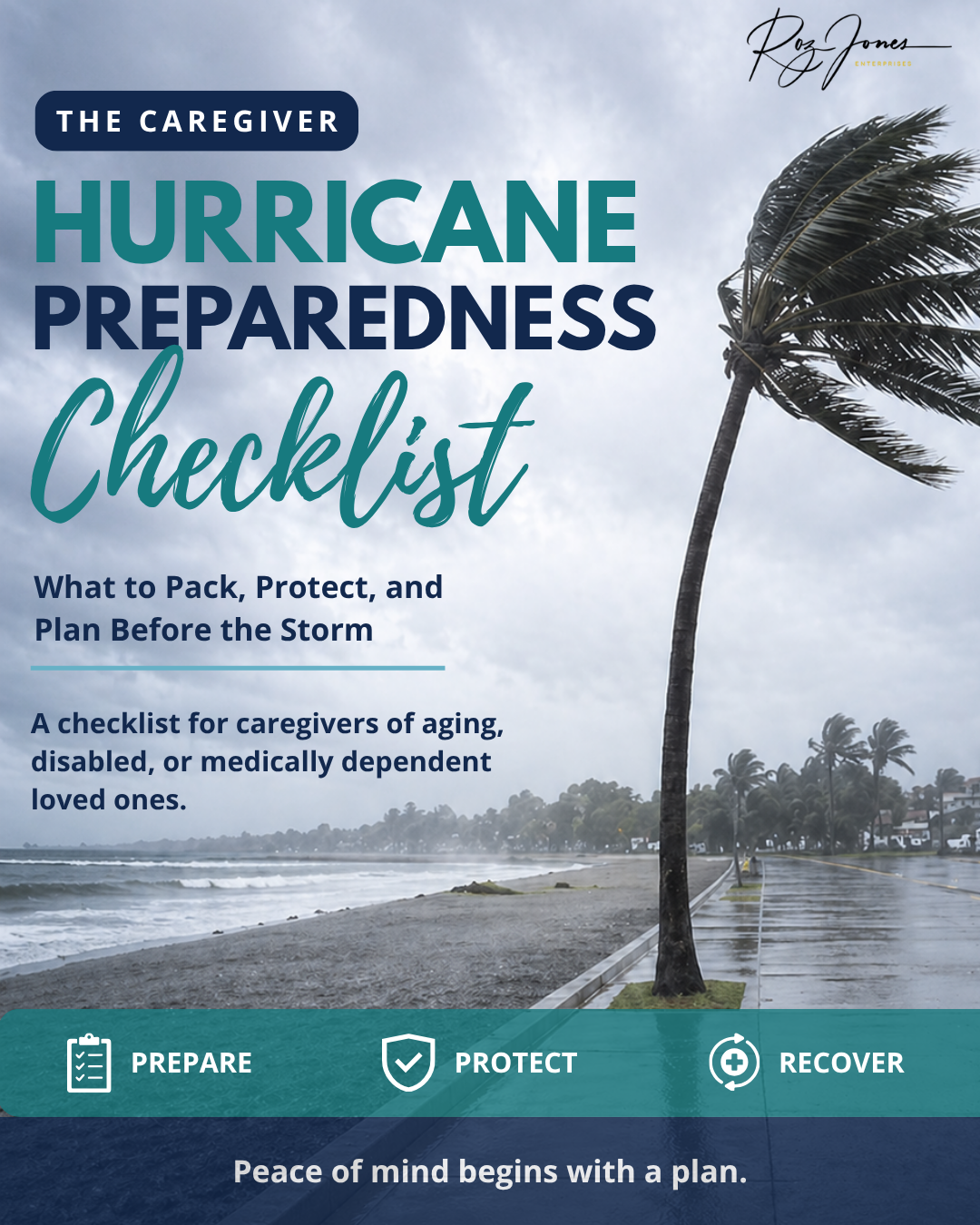
I created the Caregiver Hurricane Preparedness Checklist to help caregivers get organized before the storm is in the forecast. It is a simple, practical resource to help you think through what your aging loved one may need, what documents should be easy to access, what supplies should be ready, and what conversations need to happen before an emergency.

Purchase the Caregiver Hurricane Preparedness Checklist for $1.99 and take one small but important step toward protecting your loved one — and your peace of mind — this hurricane season.

Use Technology, But Do Not Let It Run You

Digital tools can help caregivers stay organized. Medication reminders, shared calendars, health portals, emergency contact lists, and document storage can make a big difference.

But too many apps, alerts, messages, and logins can also become another source of stress.

Keep it simple.

Choose one place for appointments.
Choose one place for medication information.
Choose one place for emergency contacts.
Choose one place for important documents.

The goal is not to have every tool. The goal is to have a system that actually supports you.

Create a Small Support Circle

You do not need a crowd. You need reliable people.

Think about who can help with specific things:

Who can sit with your loved one for an hour?
Who can pick up groceries?
Who can make a phone call?
Who can help organize paperwork?
Who can listen without judging?
Who can step in during an emergency?

Be specific when you ask for help. People often say, “Let me know if you need anything,” but they may not know what to do until you give them a clear task.

And let me be clear: asking for help does not make you less capable. It makes the care more sustainable.

Make Room for Professional Support

Sometimes your friends and family cannot hold everything you are carrying.

That is where therapy, coaching, support groups, or caregiver counseling can help. You deserve a space where the conversation is not only about your loved one’s needs, but about yours too.

You need a place to say the hard things.
The things you feel guilty admitting.
The things you are tired of carrying.
The things you do not want to say in the family group chat.

Professional support can help you process the grief, pressure, anger, fear, and fatigue that caregiving can bring.

And sometimes, you do not just need emotional support. You need a plan.

You need someone to help you look at the full picture: the care responsibilities, the family dynamics, the emergency needs, the documents, the daily routines, and the decisions that keep getting pushed down the road.

That is where a Family Care Planning Session with Roz Jones can help.

In a family care planning session, we can talk through what is happening, what needs to be organized, where support is missing, and what next steps may help you care with more clarity and less chaos.

Book a Family Care Planning Session with Roz Jones today and get support building a care plan that includes your aging loved one — and you.

Let Respite Be Part of the Plan

Respite is not abandonment.

It is not selfish.
It is not a luxury.
It is not something you only deserve when everything is falling apart.

Respite gives you space to breathe, reset, and remember that you are still a person outside of caregiving.

Whether it is a few hours, a full day, or planned support during the week, respite needs to be discussed before the crisis hits.

You Are Allowed to Have a Life Too

One of the hardest parts of caregiving is how quietly your own life can shrink.

You stop making plans.
You stop resting well.
You stop dreaming out loud.
You stop doing things that bring you joy because there is always something else that needs to be done.

But caregiving should not require you to disappear.

You are allowed to laugh.
You are allowed to go out.
You are allowed to rest.
You are allowed to want support.
You are allowed to have boundaries.
You are allowed to still be you.

Your aging loved one matters.

And so do you.

A Gentle Reminder for the Caregiver

You do not have to wait until you are at your breaking point to make a change.

Start small.

Choose one thing this week that supports your emotional well-being. Not ten things. Not a complete life overhaul. Just one.

Make the phone call.
Ask for help.
Take the break.
Organize the paperwork.
Say the boundary out loud.
Schedule the appointment.
Give yourself permission to breathe.

Caregiving takes strength. But real strength is not carrying everything alone.

It is knowing when to pause.
It is telling the truth about what you need.
It is preparing before the crisis.
It is asking for support before you are running on fumes.

If you have not read the first part of this conversation, take a moment to revisit Breaking the Stigma: Addressing Mental Health in Caregiving. It is an important reminder that your mental health is not separate from the care plan.

It is part of it.

Join the Moments of Grace Launch List

Caregiving asks a lot of you — emotionally, physically, mentally, and spiritually. That is why Roz Jones created Moments of Grace: A 40-Day Caregiver Prayer Journal, a faith-filled journal designed to help caregivers pause, reflect, release, and reconnect with God in the middle of the caregiving journey.

Through daily prayers, comforting scriptures, guided journal prompts, and uplifting affirmations, Moments of Grace offers caregivers a quiet place to be honest about what they are carrying while receiving encouragement for the road ahead.

Whether you are caring for an aging parent, spouse, loved one, patient, or family member, this journal is a reminder that your spirit needs care too.

Need Help Getting a Plan in Place?

The Caregiver Hurricane Preparedness Checklist.

Caregivers, please do not wait until you are exhausted, overwhelmed, or in the middle of an emergency to get organized.

Preparation is not panic.

Preparation is care.

That is why I created the Caregiver Hurricane Preparedness Checklist.

For only $1.99, this checklist helps caregivers organize important details before an emergency happens, including medications, emergency contacts, documents, supplies, evacuation needs, and care information.

Purchase the Caregiver Hurricane Preparedness Checklist for $1.99 today and give yourself one less thing to carry from memory.

When You Can’t Do it All Give Roz a Call!

Roz Jones is a dedicated caretaker turned CEO with over a decade of experience in helping families care for and make decisions for loved ones and their legacies.Roz is a compassionate, innovative healthcare industry leader.

If your caregiving situation feels bigger than a checklist, I invite you to book a Family Care Planning Session with me.

Together, we can talk through what needs to be organized, what responsibilities need to be shared, and what support needs to be put in place so you are not holding everything alone.

Let’s create a care plan that protects your loved one and supports you too.

Subscribe to The Caregiver Cafe Weekly Newsletter!

Caregiving can be a roller coaster of ups and downs. The information that you will receive from The Caregiver Cafe Weekly Specials Newsletter will support you as a caregiver. Remember…

1. YOU ARE NOT ALONE: The problems you face as a caregiver are experienced by other caregivers. Knowing that you’re not alone can be comforting. 

2. Tools and Resources:  Find caregiver stress management tools and gain perspective from other caregiver’s experiences.

3. LEARN TO: Ask for help, accept help when it is offered, and acknowledge yourself on this caregiving journey. Hear from experts on how to balance caregiving responsibilities by taking care of your needs and involving others to help manage the natural stress and isolation of being a caregiver. 

Holding It Down Without Breaking Down

By Roz Jones

Caregiving has a way of making you look strong even when you are tired.

You are the one answering the phone.
The one remembering the appointments.
The one checking the medications.
The one making sure bills, meals, transportation, and follow-ups do not fall through the cracks.

You are holding it down.

But let me ask you something honestly:

Who is holding you?

In my previous blog, The Impact of Caregiving on Mental Health and Personal Well-Being, I talked about the emotional toll, physical stress, burnout, guilt, frustration, and exhaustion that can come with caregiving. I also shared the importance of self-care, support, boundaries, counseling, respite, and asking for help.

That foundation still matters.

But today, we need to go deeper.

Because caregiving is not getting simpler. For many families, caregiving now includes medical coordination, family communication, legal paperwork, emergency planning, financial decisions, and emotional support — all while the caregiver is trying to keep their own life together too.

The 2025 Caregiving in the U.S. report from AARP and the National Alliance for Caregiving found that the nation now has about 63 million family caregivers, showing just how many people are carrying care responsibilities in their homes, families, and communities.

So if caregiving has been weighing on your mind, your body, your sleep, your peace, or your patience, you are not imagining it.

Caregiving is real work.

And you deserve a care plan that includes you.

The Mental Load Is Heavy

People often notice the visible parts of caregiving.

Driving to appointments.
Cooking meals.
Helping with bathing.
Picking up prescriptions.
Managing the house.
Running errands.

But the invisible work can be just as heavy.

The invisible work is remembering what the doctor said.

It is tracking the side effects.

It is knowing which family member needs an update.

It is worrying about whether your loved one is safe at home.

It is thinking about what happens if the power goes out, if a storm hits, if the medication runs out, or if the hospital calls in the middle of the night.

It is carrying the “what ifs.”

That kind of mental load can wear a caregiver down, especially when everyone assumes you have it handled because you make it look handled.

But looking okay is not the same thing as being okay.

Stress Does Not Always Look Like Stress

Caregiver stress does not always show up as one big breakdown.

Sometimes it looks like snapping at people you love.

Sometimes it looks like sitting in the car longer than necessary because you need a moment before walking into the house.

Sometimes it looks like forgetting things, losing patience, feeling numb, or crying over something small because you have been holding in too much.

Sometimes it looks like guilt.

Guilt for being tired.
Guilt for wanting help.
Guilt for needing space.
Guilt for feeling frustrated with someone you love.

And sometimes it looks like resentment because you are doing the work, but other people are offering opinions instead of support.

According to 2025 caregiver research from the National Alliance for Caregiving, two-thirds of family caregivers report moderate to high emotional stress, and one in four report feeling isolated.

That isolation matters.

Because when caregivers feel alone, they often stop asking for what they need.

They push through.

They normalize exhaustion.

They tell themselves, “It’s just what I have to do.”

But no caregiver should have to disappear inside the role.

Your Body Is Talking Too

Caregiving does not only affect your emotions.

It can show up in your body.

Headaches.
Back pain.
Fatigue.
Stomach issues.
Poor sleep.
Changes in appetite.
Tension in your shoulders.
Feeling like you are always on alert.

That constant state of responsibility can take a real toll.

The CDC has reported that caregivers have shown higher levels of frequent mental distress and lifetime depression compared with non-caregivers, which is a reminder that caregiver health needs to be taken seriously.

Caregivers, your health is not optional.

Your appointments matter too.

Your sleep matters too.

Your meals matter too.

Your peace matters too.

You cannot keep treating your body like it is only there to get everybody else through.

Self-Care Is Not Enough Without Structure

Now let’s talk plainly.

Self-care matters.

But self-care cannot be the only answer when the caregiving system is broken.

A bubble bath will not fix the fact that you are the only one managing appointments.

A walk will not fix the stress of not knowing where the emergency documents are.

A journal will not replace a family conversation.

A nap will not solve a care plan that depends on one person doing everything.

Self-care helps you breathe.

Structure helps you sustain.

That structure may look like:

  • Creating a written care plan
  • Dividing responsibilities among family members
  • Keeping a current medication list
  • Organizing emergency contacts
  • Knowing where important documents are stored
  • Setting clear boundaries around time and money
  • Scheduling respite care or backup support
  • Having family care planning conversations before a crisis

This is the part many families skip.

They wait until something happens.

Then everyone is stressed, emotional, confused, and trying to make decisions quickly.

Caregivers need support before the breaking point.

Boundaries Are Not Being Mean

A lot of caregivers struggle with boundaries because they feel like saying “no” means they do not care.

But boundaries are not rejection.

Boundaries are protection.

You can love someone and still say:

  • “I cannot be available every day.”
  • “I need help with transportation.”
  • “I am not able to cover these expenses.”
  • “I need someone else to manage the pharmacy calls.”
  • “I cannot keep missing work without a plan.”
  • “We need a family meeting.”
  • “I need rest before I can make another decision.”

That is not being difficult.

That is being honest.

And honesty is what keeps caregiving from turning into quiet resentment.

When you do not set boundaries, the care may continue, but the caregiver starts to suffer.

And eventually, that suffering affects everybody.

Emergency Planning Protects Your Peace

When we talk about caregiver well-being, emergency planning may not be the first thing people think about.

But it should be.

Because nothing increases caregiver stress like being unprepared during a crisis.

A hurricane.
A power outage.
A hospital visit.
A fall.
An evacuation.
A medication issue.
A sudden change in health.

These moments are already stressful.

But they become even harder when nobody knows where the documents are, who to call, what medications are needed, what insurance information is current, or what the plan is if your loved one cannot safely stay home.

When you have the list, the documents, the contacts, the supplies, and the plan, you are not scrambling from scratch.

You are responding with direction.

And caregivers need that kind of relief.

Caregiving Should Not Be a Solo Performance

Some caregivers are surrounded by people and still feel alone.

Because people may visit, call, comment, or check in — but that does not mean they are sharing the responsibility.

There is a difference between concern and help.

  • Concern says, “Let me know if you need anything.”
  • Help says, “I can take over the grocery order every Thursday.”
  • Concern says, “You’re so strong.”
  • Help says, “I’ll sit with Mom for three hours so you can rest.”
  • Concern says, “I know this is hard.”
  • Help says, “Send me the bill login. I’ll help organize payments.”

Caregivers do not just need compliments.

Caregivers need participation.

If you are the main caregiver, it may be time to stop asking generally and start asking specifically.

Do not say, “I need help.”

Say:

“I need you to take over prescription refills.”

“I need you to come every Saturday morning.”

“I need you to be the emergency contact when I am at work.”

“I need you to help pay for respite care.”

“I need you to attend the next care planning meeting.”

Clear asks create clearer support.

The Care Plan Includes You

Caregivers, I want you to remember this:

You are not just the person providing care.

You are a person who needs care too.

Your life still matters.

Your dreams still matter.

Your health still matters.

Your rest still matters.

Your relationships still matter.

Your future still matters.

Caregiving may be part of your life right now, but it cannot be allowed to consume all of you.

You can love your aging loved one deeply and still need help.

You can be committed and still be tired.

You can be grateful and still be overwhelmed.

You can be responsible and still need boundaries.

You can hold it down without breaking down — but only if the care plan includes support for you too.

Need Help Getting a Plan in Place?

The Caregiver Hurricane Preparedness Checklist.

Caregivers, please do not wait until you are exhausted, overwhelmed, or in the middle of an emergency to get organized.

Preparation is not panic.

Preparation is care.

That is why I created the Caregiver Hurricane Preparedness Checklist.

For only $1.99, this checklist helps caregivers organize important details before an emergency happens, including medications, emergency contacts, documents, supplies, evacuation needs, and care information.

Purchase the Caregiver Hurricane Preparedness Checklist for $1.99 today and give yourself one less thing to carry from memory.

When You Can’t Do it All Give Roz a Call!

Roz Jones is a dedicated caretaker turned CEO with over a decade of experience in helping families care for and make decisions for loved ones and their legacies.Roz is a compassionate, innovative healthcare industry leader.

If your caregiving situation feels bigger than a checklist, I invite you to book a Family Care Planning Session with me.

Together, we can talk through what needs to be organized, what responsibilities need to be shared, and what support needs to be put in place so you are not holding everything alone.

Let’s create a care plan that protects your loved one and supports you too.

Subscribe to The Caregiver Cafe Weekly Newsletter!

Caregiving can be a roller coaster of ups and downs. The information that you will receive from The Caregiver Cafe Weekly Specials Newsletter will support you as a caregiver. Remember…

1. YOU ARE NOT ALONE: The problems you face as a caregiver are experienced by other caregivers. Knowing that you’re not alone can be comforting. 

2. Tools and Resources:  Find caregiver stress management tools and gain perspective from other caregiver’s experiences.

3. LEARN TO: Ask for help, accept help when it is offered, and acknowledge yourself on this caregiving journey. Hear from experts on how to balance caregiving responsibilities by taking care of your needs and involving others to help manage the natural stress and isolation of being a caregiver. 

The Caregiver’s Quiet Breaking Point

By Roz Jones

There is a breaking point caregivers do not always talk about.

It may not look like yelling.
It may not look like falling apart.
It may not look like walking away.

Sometimes it looks like sitting in the car before going inside because you need one more minute.

Sometimes it looks like staring at your phone when it rings and feeling your whole body tense up.

Sometimes it looks like forgetting simple things because your mind is holding too much.

Sometimes it looks like saying, “I’m fine,” when you are tired, overwhelmed, and one more request away from tears.

That is the quiet breaking point.

And many caregivers know it well.

In my previous blog, The Intersection of Mental Health and Caregiving for an Aging Loved One, I talked about the emotional challenges caregivers often face, including stress, anxiety, guilt, grief, burnout, depression, and the importance of self-care, support, communication, respite care, counseling, and asking for help.

Because caregiving does not only change your schedule.

It can change your mood, your body, your relationships, your patience, your sleep, your peace, and the way you move through the world.

And if nobody checks on the caregiver, the caregiver can reach a breaking point quietly.

When You Are Always “The One”

There is a certain weight that comes with being the one everybody depends on.

The one who remembers the appointments.
The one who calls the pharmacy.
The one who notices the changes.
The one who keeps track of the paperwork.
The one who updates the family.
The one who shows up when everyone else is busy.
The one who is expected to be strong because you have been strong for so long.

Being dependable is a beautiful thing.

But being depended on without support can become exhausting.

Caregivers are often praised for being strong, but not always supported in a way that actually helps.

Someone may say, “You’re doing such a good job,” but never offer to sit with your loved one.

Someone may say, “Let me know if you need anything,” but disappear when you ask for something specific.

Someone may have plenty of opinions about the care, but no real availability to share the work.

That kind of imbalance can wear on your mental health.

Not all at once.

Little by little.

Caregiving Can Stir Up Everything

Caring for an aging loved one can bring up emotions that do not fit neatly into one category.

You may feel love and resentment in the same afternoon.

You may feel grateful for more time with them and still grieve who they used to be.

You may want to help and still feel trapped by how much help is needed.

You may feel guilty for needing space.

You may feel angry that other people are not doing more.

You may feel sad watching your loved one lose independence, memory, mobility, confidence, or control.

And if there is family history, caregiving can bring that history right back into the room.

Old wounds.

Old roles.

Old expectations.

Old arguments.

Old patterns where one person carries the weight and everyone else assumes that is just how it is.

Caregiving is not only about what is happening now.

Sometimes it also touches everything that happened before.

That is why your mental health matters.

Because you are not just managing tasks.

You are managing emotions, memories, responsibilities, and relationships all at once.

The Mental Load Can Become Too Much

People can see the visible parts of caregiving.

They can see you driving to appointments, picking up groceries, organizing medication, cleaning the house, answering calls, and helping with daily needs.

But they may not see the invisible work.

The constant thinking.

The remembering.

The planning.

The worrying.

The listening for changes in your loved one’s voice.

The checking your phone to make sure you did not miss a call.

The wondering what happens if there is a fall, a hospital visit, a hurricane, a power outage, or a sudden emergency.

That mental load can feel like too many tabs open in your mind at the same time.

And even when you are supposed to be resting, part of you may still be on alert.

This is why caregivers need more than encouragement.

You need systems that help you stop carrying every detail from memory.

A current medication list.
A folder for important documents.
An emergency contact list.
A plan for appointments.
A backup caregiver.
A storm plan.
A family care plan.

These are not just organizational tools.

They are stress reducers.

They give your mind somewhere to place what it has been trying to hold alone.

Mental Health Is Part of the Care Plan

Caregivers often put their own mental health at the bottom of the list.

You tell yourself you will rest after the next appointment.

You will call the therapist after things calm down.

You will ask for help after the hospital discharge.

You will take a break after the family meeting.

You will deal with your own feelings later.

But later keeps moving.

And the care keeps growing.

Your mental health cannot be an afterthought. Not when you are making decisions, managing crises, communicating with family, advocating at appointments, and trying to keep your own life together.

If you are more irritable than usual, that matters.

If you are not sleeping, that matters.

If you are crying more often, that matters.

If you feel numb, that matters.

If you are avoiding calls, forgetting things, feeling anxious, or feeling like you are always bracing for the next problem, that matters too.

You do not have to wait until you fall apart to take your mental health seriously.

Support is not only for crisis.

Support is how you stay steady before everything becomes a crisis.

Communication Has to Get Clearer

One of the hardest parts of caregiving is that people often assume the main caregiver has everything handled.

Especially when you are capable.

Especially when you are organized.

Especially when you are the one who usually figures things out.

But being capable does not mean you should be carrying everything alone.

Sometimes family members need direct communication, not hints.

Instead of saying, “I need help,” try saying:

  • “I need you to handle pharmacy refills this month.”
  • “I need you to take Mom to her appointment on Thursday.”
  • “I need you to sit with Dad for three hours on Saturday so I can rest.”
  • “I need us to meet and talk about the emergency plan.”
  • “I need help paying for respite care.”
  • “I need you to be the backup contact if I am unavailable.”

Clear communication may feel uncomfortable at first, but it reduces confusion.

It also makes it harder for others to pretend they did not know what was needed.

Caregivers do not need vague concern.

Caregivers need shared responsibility.

Boundaries Are Care Too

Boundaries are not a lack of love.

Boundaries are what help love survive the pressure.

You may need to say:

  • “I cannot answer calls after 9 p.m. unless it is an emergency.”
  • “I cannot keep missing work without a backup plan.”
  • “I cannot pay for these expenses by myself.”
  • “I can help with appointments, but I cannot manage everything alone.”
  • “I need a break before I make another decision.”
  • “I need other family members involved.”

That is not selfish.

That is honest.

And honesty protects both the caregiver and the person receiving care.

When caregivers have no boundaries, resentment can build quietly.

Exhaustion can become normal.

Stress can become part of your personality.

And the breaking point gets closer.

Emergency Planning Protects Your Peace

When we talk about caregiver mental health, emergency planning may not be the first thing people think about.

But it should be.

Because nothing drains a caregiver faster than a crisis with no plan.

A hurricane.
A power outage.
A hospitalization.
A fall.
An evacuation.
A sudden change in health.

These moments are stressful enough on their own.

But they become even heavier when nobody knows where the documents are, what medications are needed, who should be called, what supplies are required, or what the plan is if your loved one cannot safely stay home.

Preparation does not remove every worry.

But it does reduce the chaos.

It helps you move from panic to action.

It gives family members something clear to follow.

It gives the caregiver a little room to breathe.

That matters.

Because the person holding the care plan should not also have to invent the plan in the middle of an emergency.

You Deserve Support Before You Break

Caregivers, please hear me.

You do not have to wait until you are angry, exhausted, sick, resentful, or completely overwhelmed before you ask for help.

You do not have to earn rest by reaching your limit.

You do not have to prove your love by sacrificing your mental health.

You are allowed to need support now.

You are allowed to need a plan now.

You are allowed to say, “This is too much for one person.”

You are allowed to care deeply and still admit that caregiving is affecting you.

The goal is not to stop caring.

The goal is to care in a way that does not cost you yourself.

Need Help Before the Breaking Point Becomes a Crisis?

The Caregiver Hurricane Preparedness Checklist.

Caregivers, please do not wait until the storm is coming, the hospital calls, the medication list is missing, or the family is scrambling to figure out what should have already been written down.

Preparation is not panic.
Preparation is care.

That is why I created the Caregiver Hurricane Preparedness Checklist. For only $1.99, this checklist helps you organize the important details before an emergency happens, including medications, emergency contacts, documents, supplies, evacuation needs, and care information.Purchase the Caregiver Hurricane Preparedness Checklist today and give yourself one less thing to carry from me

When You Can’t Do it All Give Roz a Call!

Roz Jones is a dedicated caretaker turned CEO with over a decade of experience in helping families care for and make decisions for loved ones and their legacies.Roz is a compassionate, innovative healthcare industry leader.

If your caregiving situation feels bigger than a checklist, I invite you to book a Family Care Planning Session with me.

Together, we can look at what needs to be organized, what conversations need to happen, who needs to be involved, and what support needs to be put in place so you are not carrying the care plan alone.

You deserve support before you break.

Subscribe to The Caregiver Cafe Weekly Newsletter!

Caregiving can be a roller coaster of ups and downs. The information that you will receive from The Caregiver Cafe Weekly Specials Newsletter will support you as a caregiver. Remember…

1. YOU ARE NOT ALONE: The problems you face as a caregiver are experienced by other caregivers. Knowing that you’re not alone can be comforting. 

2. Tools and Resources:  Find caregiver stress management tools and gain perspective from other caregiver’s experiences.

3. LEARN TO: Ask for help, accept help when it is offered, and acknowledge yourself on this caregiving journey. Hear from experts on how to balance caregiving responsibilities by taking care of your needs and involving others to help manage the natural stress and isolation of being a caregiver.