Holding It Down Without Breaking Down

By Roz Jones

Caregiving has a way of making you look strong even when you are tired.

You are the one answering the phone.
The one remembering the appointments.
The one checking the medications.
The one making sure bills, meals, transportation, and follow-ups do not fall through the cracks.

You are holding it down.

But let me ask you something honestly:

Who is holding you?

In my previous blog, The Impact of Caregiving on Mental Health and Personal Well-Being, I talked about the emotional toll, physical stress, burnout, guilt, frustration, and exhaustion that can come with caregiving. I also shared the importance of self-care, support, boundaries, counseling, respite, and asking for help.

That foundation still matters.

But today, we need to go deeper.

Because caregiving is not getting simpler. For many families, caregiving now includes medical coordination, family communication, legal paperwork, emergency planning, financial decisions, and emotional support — all while the caregiver is trying to keep their own life together too.

The 2025 Caregiving in the U.S. report from AARP and the National Alliance for Caregiving found that the nation now has about 63 million family caregivers, showing just how many people are carrying care responsibilities in their homes, families, and communities.

So if caregiving has been weighing on your mind, your body, your sleep, your peace, or your patience, you are not imagining it.

Caregiving is real work.

And you deserve a care plan that includes you.

The Mental Load Is Heavy

People often notice the visible parts of caregiving.

Driving to appointments.
Cooking meals.
Helping with bathing.
Picking up prescriptions.
Managing the house.
Running errands.

But the invisible work can be just as heavy.

The invisible work is remembering what the doctor said.

It is tracking the side effects.

It is knowing which family member needs an update.

It is worrying about whether your loved one is safe at home.

It is thinking about what happens if the power goes out, if a storm hits, if the medication runs out, or if the hospital calls in the middle of the night.

It is carrying the “what ifs.”

That kind of mental load can wear a caregiver down, especially when everyone assumes you have it handled because you make it look handled.

But looking okay is not the same thing as being okay.

Stress Does Not Always Look Like Stress

Caregiver stress does not always show up as one big breakdown.

Sometimes it looks like snapping at people you love.

Sometimes it looks like sitting in the car longer than necessary because you need a moment before walking into the house.

Sometimes it looks like forgetting things, losing patience, feeling numb, or crying over something small because you have been holding in too much.

Sometimes it looks like guilt.

Guilt for being tired.
Guilt for wanting help.
Guilt for needing space.
Guilt for feeling frustrated with someone you love.

And sometimes it looks like resentment because you are doing the work, but other people are offering opinions instead of support.

According to 2025 caregiver research from the National Alliance for Caregiving, two-thirds of family caregivers report moderate to high emotional stress, and one in four report feeling isolated.

That isolation matters.

Because when caregivers feel alone, they often stop asking for what they need.

They push through.

They normalize exhaustion.

They tell themselves, “It’s just what I have to do.”

But no caregiver should have to disappear inside the role.

Your Body Is Talking Too

Caregiving does not only affect your emotions.

It can show up in your body.

Headaches.
Back pain.
Fatigue.
Stomach issues.
Poor sleep.
Changes in appetite.
Tension in your shoulders.
Feeling like you are always on alert.

That constant state of responsibility can take a real toll.

The CDC has reported that caregivers have shown higher levels of frequent mental distress and lifetime depression compared with non-caregivers, which is a reminder that caregiver health needs to be taken seriously.

Caregivers, your health is not optional.

Your appointments matter too.

Your sleep matters too.

Your meals matter too.

Your peace matters too.

You cannot keep treating your body like it is only there to get everybody else through.

Self-Care Is Not Enough Without Structure

Now let’s talk plainly.

Self-care matters.

But self-care cannot be the only answer when the caregiving system is broken.

A bubble bath will not fix the fact that you are the only one managing appointments.

A walk will not fix the stress of not knowing where the emergency documents are.

A journal will not replace a family conversation.

A nap will not solve a care plan that depends on one person doing everything.

Self-care helps you breathe.

Structure helps you sustain.

That structure may look like:

  • Creating a written care plan
  • Dividing responsibilities among family members
  • Keeping a current medication list
  • Organizing emergency contacts
  • Knowing where important documents are stored
  • Setting clear boundaries around time and money
  • Scheduling respite care or backup support
  • Having family care planning conversations before a crisis

This is the part many families skip.

They wait until something happens.

Then everyone is stressed, emotional, confused, and trying to make decisions quickly.

Caregivers need support before the breaking point.

Boundaries Are Not Being Mean

A lot of caregivers struggle with boundaries because they feel like saying “no” means they do not care.

But boundaries are not rejection.

Boundaries are protection.

You can love someone and still say:

  • “I cannot be available every day.”
  • “I need help with transportation.”
  • “I am not able to cover these expenses.”
  • “I need someone else to manage the pharmacy calls.”
  • “I cannot keep missing work without a plan.”
  • “We need a family meeting.”
  • “I need rest before I can make another decision.”

That is not being difficult.

That is being honest.

And honesty is what keeps caregiving from turning into quiet resentment.

When you do not set boundaries, the care may continue, but the caregiver starts to suffer.

And eventually, that suffering affects everybody.

Emergency Planning Protects Your Peace

When we talk about caregiver well-being, emergency planning may not be the first thing people think about.

But it should be.

Because nothing increases caregiver stress like being unprepared during a crisis.

A hurricane.
A power outage.
A hospital visit.
A fall.
An evacuation.
A medication issue.
A sudden change in health.

These moments are already stressful.

But they become even harder when nobody knows where the documents are, who to call, what medications are needed, what insurance information is current, or what the plan is if your loved one cannot safely stay home.

When you have the list, the documents, the contacts, the supplies, and the plan, you are not scrambling from scratch.

You are responding with direction.

And caregivers need that kind of relief.

Caregiving Should Not Be a Solo Performance

Some caregivers are surrounded by people and still feel alone.

Because people may visit, call, comment, or check in — but that does not mean they are sharing the responsibility.

There is a difference between concern and help.

  • Concern says, “Let me know if you need anything.”
  • Help says, “I can take over the grocery order every Thursday.”
  • Concern says, “You’re so strong.”
  • Help says, “I’ll sit with Mom for three hours so you can rest.”
  • Concern says, “I know this is hard.”
  • Help says, “Send me the bill login. I’ll help organize payments.”

Caregivers do not just need compliments.

Caregivers need participation.

If you are the main caregiver, it may be time to stop asking generally and start asking specifically.

Do not say, “I need help.”

Say:

“I need you to take over prescription refills.”

“I need you to come every Saturday morning.”

“I need you to be the emergency contact when I am at work.”

“I need you to help pay for respite care.”

“I need you to attend the next care planning meeting.”

Clear asks create clearer support.

The Care Plan Includes You

Caregivers, I want you to remember this:

You are not just the person providing care.

You are a person who needs care too.

Your life still matters.

Your dreams still matter.

Your health still matters.

Your rest still matters.

Your relationships still matter.

Your future still matters.

Caregiving may be part of your life right now, but it cannot be allowed to consume all of you.

You can love your aging loved one deeply and still need help.

You can be committed and still be tired.

You can be grateful and still be overwhelmed.

You can be responsible and still need boundaries.

You can hold it down without breaking down — but only if the care plan includes support for you too.

Need Help Getting a Plan in Place?

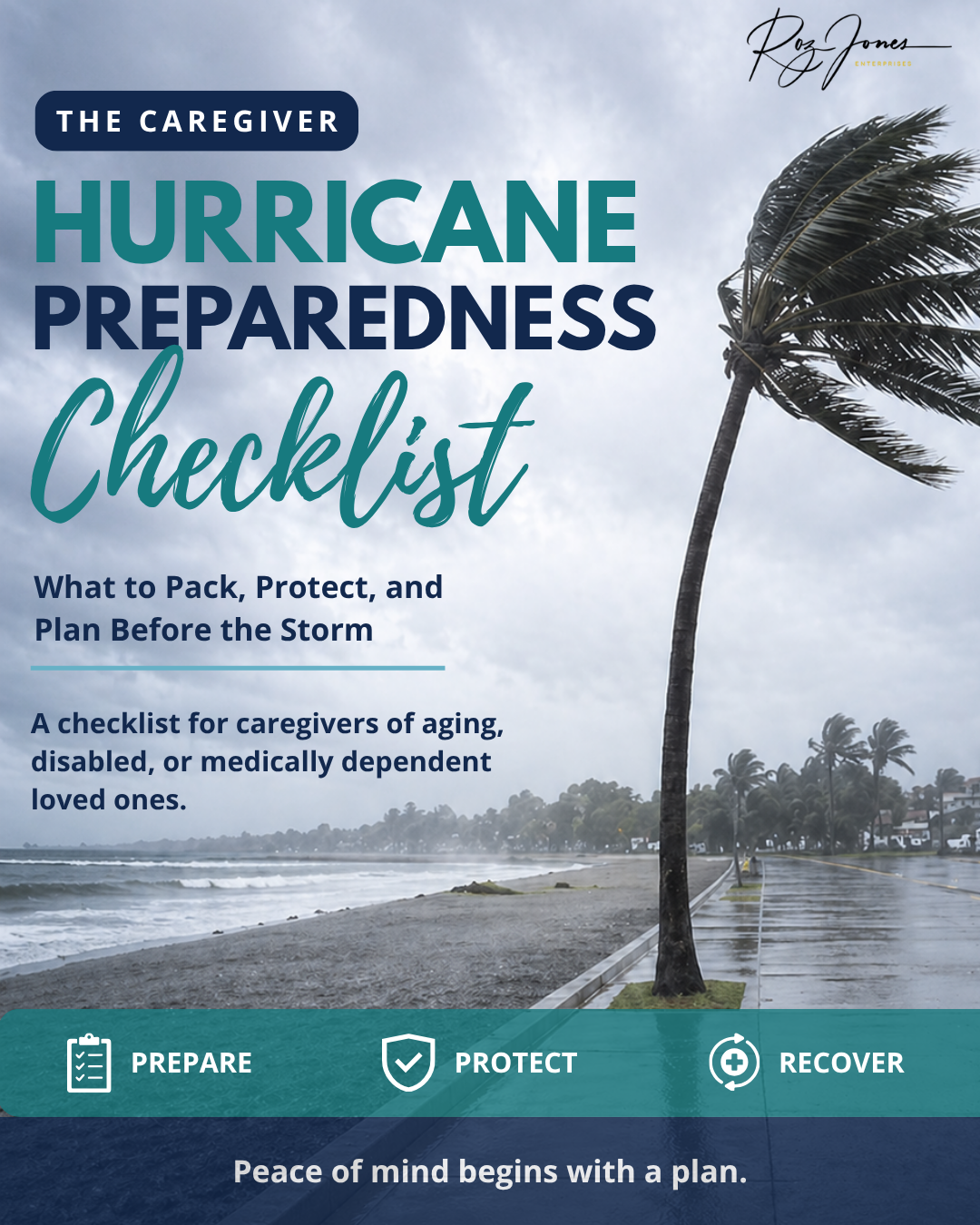
The Caregiver Hurricane Preparedness Checklist.

Caregivers, please do not wait until you are exhausted, overwhelmed, or in the middle of an emergency to get organized.

Preparation is not panic.

Preparation is care.

That is why I created the Caregiver Hurricane Preparedness Checklist.

For only $1.99, this checklist helps caregivers organize important details before an emergency happens, including medications, emergency contacts, documents, supplies, evacuation needs, and care information.

Purchase the Caregiver Hurricane Preparedness Checklist for $1.99 today and give yourself one less thing to carry from memory.

When You Can’t Do it All Give Roz a Call!

Roz Jones is a dedicated caretaker turned CEO with over a decade of experience in helping families care for and make decisions for loved ones and their legacies.Roz is a compassionate, innovative healthcare industry leader.

If your caregiving situation feels bigger than a checklist, I invite you to book a Family Care Planning Session with me.

Together, we can talk through what needs to be organized, what responsibilities need to be shared, and what support needs to be put in place so you are not holding everything alone.

Let’s create a care plan that protects your loved one and supports you too.

Subscribe to The Caregiver Cafe Weekly Newsletter!

Caregiving can be a roller coaster of ups and downs. The information that you will receive from The Caregiver Cafe Weekly Specials Newsletter will support you as a caregiver. Remember…

1. YOU ARE NOT ALONE: The problems you face as a caregiver are experienced by other caregivers. Knowing that you’re not alone can be comforting. 

2. Tools and Resources:  Find caregiver stress management tools and gain perspective from other caregiver’s experiences.

3. LEARN TO: Ask for help, accept help when it is offered, and acknowledge yourself on this caregiving journey. Hear from experts on how to balance caregiving responsibilities by taking care of your needs and involving others to help manage the natural stress and isolation of being a caregiver. 

The Caregiver’s Quiet Breaking Point

By Roz Jones

There is a breaking point caregivers do not always talk about.

It may not look like yelling.
It may not look like falling apart.
It may not look like walking away.

Sometimes it looks like sitting in the car before going inside because you need one more minute.

Sometimes it looks like staring at your phone when it rings and feeling your whole body tense up.

Sometimes it looks like forgetting simple things because your mind is holding too much.

Sometimes it looks like saying, “I’m fine,” when you are tired, overwhelmed, and one more request away from tears.

That is the quiet breaking point.

And many caregivers know it well.

In my previous blog, The Intersection of Mental Health and Caregiving for an Aging Loved One, I talked about the emotional challenges caregivers often face, including stress, anxiety, guilt, grief, burnout, depression, and the importance of self-care, support, communication, respite care, counseling, and asking for help.

Because caregiving does not only change your schedule.

It can change your mood, your body, your relationships, your patience, your sleep, your peace, and the way you move through the world.

And if nobody checks on the caregiver, the caregiver can reach a breaking point quietly.

When You Are Always “The One”

There is a certain weight that comes with being the one everybody depends on.

The one who remembers the appointments.
The one who calls the pharmacy.
The one who notices the changes.
The one who keeps track of the paperwork.
The one who updates the family.
The one who shows up when everyone else is busy.
The one who is expected to be strong because you have been strong for so long.

Being dependable is a beautiful thing.

But being depended on without support can become exhausting.

Caregivers are often praised for being strong, but not always supported in a way that actually helps.

Someone may say, “You’re doing such a good job,” but never offer to sit with your loved one.

Someone may say, “Let me know if you need anything,” but disappear when you ask for something specific.

Someone may have plenty of opinions about the care, but no real availability to share the work.

That kind of imbalance can wear on your mental health.

Not all at once.

Little by little.

Caregiving Can Stir Up Everything

Caring for an aging loved one can bring up emotions that do not fit neatly into one category.

You may feel love and resentment in the same afternoon.

You may feel grateful for more time with them and still grieve who they used to be.

You may want to help and still feel trapped by how much help is needed.

You may feel guilty for needing space.

You may feel angry that other people are not doing more.

You may feel sad watching your loved one lose independence, memory, mobility, confidence, or control.

And if there is family history, caregiving can bring that history right back into the room.

Old wounds.

Old roles.

Old expectations.

Old arguments.

Old patterns where one person carries the weight and everyone else assumes that is just how it is.

Caregiving is not only about what is happening now.

Sometimes it also touches everything that happened before.

That is why your mental health matters.

Because you are not just managing tasks.

You are managing emotions, memories, responsibilities, and relationships all at once.

The Mental Load Can Become Too Much

People can see the visible parts of caregiving.

They can see you driving to appointments, picking up groceries, organizing medication, cleaning the house, answering calls, and helping with daily needs.

But they may not see the invisible work.

The constant thinking.

The remembering.

The planning.

The worrying.

The listening for changes in your loved one’s voice.

The checking your phone to make sure you did not miss a call.

The wondering what happens if there is a fall, a hospital visit, a hurricane, a power outage, or a sudden emergency.

That mental load can feel like too many tabs open in your mind at the same time.

And even when you are supposed to be resting, part of you may still be on alert.

This is why caregivers need more than encouragement.

You need systems that help you stop carrying every detail from memory.

A current medication list.
A folder for important documents.
An emergency contact list.
A plan for appointments.
A backup caregiver.
A storm plan.
A family care plan.

These are not just organizational tools.

They are stress reducers.

They give your mind somewhere to place what it has been trying to hold alone.

Mental Health Is Part of the Care Plan

Caregivers often put their own mental health at the bottom of the list.

You tell yourself you will rest after the next appointment.

You will call the therapist after things calm down.

You will ask for help after the hospital discharge.

You will take a break after the family meeting.

You will deal with your own feelings later.

But later keeps moving.

And the care keeps growing.

Your mental health cannot be an afterthought. Not when you are making decisions, managing crises, communicating with family, advocating at appointments, and trying to keep your own life together.

If you are more irritable than usual, that matters.

If you are not sleeping, that matters.

If you are crying more often, that matters.

If you feel numb, that matters.

If you are avoiding calls, forgetting things, feeling anxious, or feeling like you are always bracing for the next problem, that matters too.

You do not have to wait until you fall apart to take your mental health seriously.

Support is not only for crisis.

Support is how you stay steady before everything becomes a crisis.

Communication Has to Get Clearer

One of the hardest parts of caregiving is that people often assume the main caregiver has everything handled.

Especially when you are capable.

Especially when you are organized.

Especially when you are the one who usually figures things out.

But being capable does not mean you should be carrying everything alone.

Sometimes family members need direct communication, not hints.

Instead of saying, “I need help,” try saying:

  • “I need you to handle pharmacy refills this month.”
  • “I need you to take Mom to her appointment on Thursday.”
  • “I need you to sit with Dad for three hours on Saturday so I can rest.”
  • “I need us to meet and talk about the emergency plan.”
  • “I need help paying for respite care.”
  • “I need you to be the backup contact if I am unavailable.”

Clear communication may feel uncomfortable at first, but it reduces confusion.

It also makes it harder for others to pretend they did not know what was needed.

Caregivers do not need vague concern.

Caregivers need shared responsibility.

Boundaries Are Care Too

Boundaries are not a lack of love.

Boundaries are what help love survive the pressure.

You may need to say:

  • “I cannot answer calls after 9 p.m. unless it is an emergency.”
  • “I cannot keep missing work without a backup plan.”
  • “I cannot pay for these expenses by myself.”
  • “I can help with appointments, but I cannot manage everything alone.”
  • “I need a break before I make another decision.”
  • “I need other family members involved.”

That is not selfish.

That is honest.

And honesty protects both the caregiver and the person receiving care.

When caregivers have no boundaries, resentment can build quietly.

Exhaustion can become normal.

Stress can become part of your personality.

And the breaking point gets closer.

Emergency Planning Protects Your Peace

When we talk about caregiver mental health, emergency planning may not be the first thing people think about.

But it should be.

Because nothing drains a caregiver faster than a crisis with no plan.

A hurricane.
A power outage.
A hospitalization.
A fall.
An evacuation.
A sudden change in health.

These moments are stressful enough on their own.

But they become even heavier when nobody knows where the documents are, what medications are needed, who should be called, what supplies are required, or what the plan is if your loved one cannot safely stay home.

Preparation does not remove every worry.

But it does reduce the chaos.

It helps you move from panic to action.

It gives family members something clear to follow.

It gives the caregiver a little room to breathe.

That matters.

Because the person holding the care plan should not also have to invent the plan in the middle of an emergency.

You Deserve Support Before You Break

Caregivers, please hear me.

You do not have to wait until you are angry, exhausted, sick, resentful, or completely overwhelmed before you ask for help.

You do not have to earn rest by reaching your limit.

You do not have to prove your love by sacrificing your mental health.

You are allowed to need support now.

You are allowed to need a plan now.

You are allowed to say, “This is too much for one person.”

You are allowed to care deeply and still admit that caregiving is affecting you.

The goal is not to stop caring.

The goal is to care in a way that does not cost you yourself.

Need Help Before the Breaking Point Becomes a Crisis?

The Caregiver Hurricane Preparedness Checklist.

Caregivers, please do not wait until the storm is coming, the hospital calls, the medication list is missing, or the family is scrambling to figure out what should have already been written down.

Preparation is not panic.
Preparation is care.

That is why I created the Caregiver Hurricane Preparedness Checklist. For only $1.99, this checklist helps you organize the important details before an emergency happens, including medications, emergency contacts, documents, supplies, evacuation needs, and care information.Purchase the Caregiver Hurricane Preparedness Checklist today and give yourself one less thing to carry from me

When You Can’t Do it All Give Roz a Call!

Roz Jones is a dedicated caretaker turned CEO with over a decade of experience in helping families care for and make decisions for loved ones and their legacies.Roz is a compassionate, innovative healthcare industry leader.

If your caregiving situation feels bigger than a checklist, I invite you to book a Family Care Planning Session with me.

Together, we can look at what needs to be organized, what conversations need to happen, who needs to be involved, and what support needs to be put in place so you are not carrying the care plan alone.

You deserve support before you break.

Subscribe to The Caregiver Cafe Weekly Newsletter!

Caregiving can be a roller coaster of ups and downs. The information that you will receive from The Caregiver Cafe Weekly Specials Newsletter will support you as a caregiver. Remember…

1. YOU ARE NOT ALONE: The problems you face as a caregiver are experienced by other caregivers. Knowing that you’re not alone can be comforting. 

2. Tools and Resources:  Find caregiver stress management tools and gain perspective from other caregiver’s experiences.

3. LEARN TO: Ask for help, accept help when it is offered, and acknowledge yourself on this caregiving journey. Hear from experts on how to balance caregiving responsibilities by taking care of your needs and involving others to help manage the natural stress and isolation of being a caregiver. 

When Work and Care Collide

By Roz Jones

Caring for someone you love while trying to keep up with work can feel like living in two worlds at once.

One world expects you to show up, stay focused, meet deadlines, return calls, and keep moving. The other asks you to slow down, pay attention, respond to changes, manage appointments, solve problems, and carry the emotional weight that comes with caring for an aging loved one.

For many caregivers, the tension is not just about being busy. It is about trying to be fully present in two places that both matter deeply.

And that kind of pressure can wear on you in ways other people do not always see.

It Is More Than a Time Management Issue

When people talk about caregiving and work, they often reduce it to scheduling.

But this is not just about a planner or a calendar.

This is about mental load.
This is about emotional strain.
This is about trying to stay dependable at work while also being dependable to someone who may need more from you than they did before.

You may be at work thinking about your loved one.
You may be with your loved one thinking about work.
You may end the day feeling like you showed up everywhere, but never fully settled anywhere.

That does something to a person.

The Pressure Builds Quietly

For many caregivers, this season does not arrive all at once.

It builds.

A few appointments here.
A few more check-in calls there.
A prescription refill.
A ride to one specialist.
A little more help with forms, bills, meals, or household needs.

Then one day, you realize you are no longer simply helping. You are coordinating, carrying, remembering, adjusting, and holding together far more than you expected.

All while still trying to keep your own life moving.

Work Does Not Always Make Room for What Home Requires

One of the hardest parts of this experience is that work responsibilities often stay the same, even when caregiving responsibilities increase.

The emails still come.
The expectations still stand.
The deadlines still matter.
The bills still need to be paid.

So caregivers often find themselves trying to hold everything together without enough room to breathe.

That can create guilt in both directions.

Guilt that you are not doing enough at home.
Guilt that you are distracted at work.
Guilt that you are tired.
Guilt that you need help.
Guilt that no matter how much you are carrying, it still feels like more is needed.

Name What Feels Hardest

Before trying to fix everything, it helps to get honest about what is making this season feel so heavy.

Is it the unpredictability?
The transportation?
The constant communication?
The financial stress?
The medication management?
The emotional weight?
The lack of help?
The fear of what comes next?

When you name the real pressure points, you can start making decisions based on what is actually draining you instead of just pushing through and hoping things get easier on their own.

Build a Rhythm, Not a Perfect Balance

Perfect balance is not always realistic in caregiving.

A better goal may be rhythm.

A rhythm helps you create some steadiness in a season that can feel scattered. That might mean setting specific times to return caregiving calls, keeping appointments in one shared calendar, writing down medication notes in one place, or blocking off one part of the week to handle care-related tasks before they pile up.

The goal is not to control everything.
The goal is to create enough structure that everything does not feel urgent all the time.

Let Help Be Practical

Many caregivers hear, “Let me know if you need anything,” but still end up doing most of it alone.

Part of the problem is that vague support often creates more work. You are still left figuring out what to ask for, who can handle it, and whether they will actually follow through.

Try getting specific instead.

Ask someone to take one appointment this month.
Ask a family member to do one grocery run each week.
Ask someone to handle one phone call or paperwork task.
Ask for one consistent check-in instead of broad promises.

Specific support tends to be more useful, more realistic, and easier to accept.

Your Work Life May Need a New Conversation

Sometimes the answer is not just coping better. Sometimes the structure around you needs to shift.

That may mean asking about flexibility.
It may mean changing your schedule where possible.
It may mean using benefits you have not used before.
It may mean talking to your supervisor before you are completely overwhelmed.
It may even mean reevaluating whether your current work setup still fits the life you are living now.

That is not failure. That is responding honestly to reality.

Caregiving Affects More Than Your Schedule

Caregiving can touch every part of life.

Your focus.
Your sleep.
Your finances.
Your energy.
Your relationships.
Your ability to rest without feeling like you should be doing something else.

That is why working caregivers need more than productivity tips. They need support, clarity, and space to make thoughtful decisions instead of only reacting to the next urgent thing.

You Matter in This Too

This part is important.

Caring for someone else does not mean disappearing from your own life.

Yes, caregiving asks a lot.
Yes, work asks a lot too.
But you are still a person inside all of this.

You still need rest.
You still need support.
You still need room to breathe, think, and care for yourself in ways that are not treated like an afterthought.

You are not selfish for needing that.
You are human.If this blog spoke to what you are carrying right now, go back and read How to Juggle Caregiving and a 9-5 Job Successfully for the earlier conversation that this piece builds on. It offers another layer to the reality of balancing work, caregiving, and the many responsibilities that come with both.

When You Can’t Do it All Give Roz a Call!

Roz Jones is a dedicated caretaker turned CEO with over a decade of experience in helping families care for and make decisions for loved ones and their legacies.Roz is a compassionate, innovative healthcare industry leader.

If your family needs support talking through care decisions, roles, and next steps, book a family care planning session with Roz Jones to create more clarity before a crisis forces rushed decisions.

Purchase the Caregiving & Advance Health Directives Checklist!

Roz Jones Enterprises Caregiving & Advance Health Directives Checklist.

And if you are ready to start getting organized around these important conversations, purchase the Advanced Directives Checklist to help your family prepare with more confidence and less confusion.

Subscribe to The Caregiver Cafe Weekly Newsletter!

Caregiving can be a roller coaster of ups and downs. The information that you will receive from The Caregiver Cafe Weekly Specials Newsletter will support you as a caregiver. Remember…

1. YOU ARE NOT ALONE: The problems you face as a caregiver are experienced by other caregivers. Knowing that you’re not alone can be comforting. 

2. Tools and Resources:  Find caregiver stress management tools and gain perspective from other caregiver’s experiences.

3. LEARN TO: Ask for help, accept help when it is offered, and acknowledge yourself on this caregiving journey. Hear from experts on how to balance caregiving responsibilities by taking care of your needs and involving others to help manage the natural stress and isolation of being a caregiver. 

The Mental Load of Caregiving Today

By Roz Jones

If you have not yet read my earlier blog, The Challenges of Daily Distractions for Caregivers,”  I encourage you to start there first. It offers an important foundation for understanding how everyday interruptions can affect the caregiving experience. This blog builds on that conversation and takes a closer look at what caregiving overload can look like today.

Caregiving has always required patience, flexibility, and attention. But for many caregivers of aging loved ones, today’s distractions are not minor interruptions. They are constant demands coming from every direction.

It is the doctor’s office calling while you are at work.
It is the pharmacy delay, the stack of paperwork, the reminder about an appointment, the text you forgot to answer, the bills that still need to be paid, and the growing list of things that all feel urgent at once.

This is one of the hardest parts of caregiving that people do not always see.

The stress is not only in the physical tasks. It is in the mental load of trying to remember everything, respond to everything, and stay emotionally present while life keeps moving around you.

Distractions Look Different Now

For many caregivers, daily distractions used to mean household chores, phone calls, or trying to balance a busy schedule.

Now, distractions often come layered with responsibility. You may be coordinating care, tracking medications, handling technology, communicating with providers, keeping up with family updates, managing your own responsibilities, and still trying to make thoughtful decisions for your aging loved one.

That kind of pressure can wear you down.

It becomes harder to focus. Harder to rest. Harder to feel like you are doing enough, even when you are doing far more than most people realize.

The Mental Load Is Real

Caregivers of aging loved ones are often carrying an invisible workload that follows them everywhere.

You may be sitting in a meeting while thinking about test results.
You may be running errands while mentally reviewing prescriptions.
You may be trying to relax at home while wondering what tomorrow will bring.

Even when you are not actively caregiving in the moment, caregiving is often still running in the background of your mind.

That kind of constant mental switching can lead to exhaustion, forgetfulness, irritability, and guilt. It can also make you feel like you are never fully present anywhere.

And that often means you are overloaded.

When Everything Feels Important

One of the most difficult parts of caregiving is that so many things do matter.

Your loved one’s health matters.
Their comfort matters.
Their paperwork matters.
Their safety matters.
Your own life responsibilities still matter too.

When everything feels important, it can become difficult to tell what needs immediate attention and what can wait. That is where overwhelm tends to grow. Not because caregivers do not care, but because they care deeply about so much at once.

What Can Actually Help

There may not be a way to eliminate every distraction, but there are ways to reduce the pressure and create more steadiness in your day.

  • Get things out of your head
    • Do not rely on memory alone. Keep one central place for appointments, questions, medication notes, reminders, and follow-up tasks. Whether that is a notebook, planner, or digital note system, the goal is to stop carrying everything mentally.
  • Separate urgent from non-urgent
    • Not every interruption needs an immediate response. Some things are truly time-sensitive. Some things are simply demanding your attention. Learning the difference can protect your energy.
  • Batch what you can
    • Try setting aside specific times for calls, paperwork, scheduling, or errands related to caregiving. Even if your day cannot be perfectly structured, grouping a few tasks together can reduce some of the mental strain.
  • Ask for specific help
    • General offers of support can be hard to use. Specific requests are easier. Ask someone to pick up groceries, sit with your loved one for an hour, make one phone call, or handle one errand. Small practical help can make a real difference.
  • Respect your own capacity
    • Caregivers often push themselves past their limits and call it love. But sustainable care requires honesty about what you can carry. Boundaries are not selfish. They are part of caring well.

Planning Can Reduce the Noise

A major source of distraction in caregiving is uncertainty.

When there is no clear plan, everything feels more urgent.
When responsibilities are not clearly shared, one person often ends up holding too much.
When important decisions and documents are left unaddressed, everyday stress grows even heavier.

That is why care planning matters.

It helps families get clearer about next steps, responsibilities, priorities, and preferences before everything becomes a crisis. It also gives caregivers a stronger sense of direction, which can reduce the constant feeling of scrambling.

You Were Never Meant to Hold It All Alone

If caregiving has left you feeling scattered, exhausted, or like your mind is always in ten places at once, you are not alone.

So many caregivers of aging loved ones are trying to manage more than one person should have to manage without enough support, enough clarity, or enough room to breathe.

That is why it is so important to name what is happening honestly. These are not just distractions. They are competing demands, emotional labor, and ongoing care responsibilities that can easily become too much without support.

You do not need to wait until things get worse to create more structure and relief. If you have not already, take a moment to read The Challenges of Daily Distractions for Caregivers for the earlier part of this conversation. It is a helpful starting point for understanding how everyday caregiving interruptions can affect your well-being and your ability to stay grounded.

When You Can’t Do it All Give Roz a Call!

Roz Jones is a dedicated caretaker turned CEO with over a decade of experience in helping families care for and make decisions for loved ones and their legacies.Roz is a compassionate, innovative healthcare industry leader.

If your family is feeling overwhelmed or unprepared, this may be the right time to put a clearer plan in place. Book a family care planning session with Roz Jones for support in navigating caregiving responsibilities, conversations, and next steps.

Purchase the Caregiving & Advance Health Directives Checklist!

Roz Jones Enterprises Caregiving & Advance Health Directives Checklist.

If you are ready to begin organizing important decisions and documents, purchase the Advanced Directives Checklist to help your family move forward with more clarity and confidence.

Subscribe to The Caregiver Cafe Weekly Newsletter!

Caregiving can be a roller coaster of ups and downs. The information that you will receive from The Caregiver Cafe Weekly Specials Newsletter will support you as a caregiver. Remember…

1. YOU ARE NOT ALONE: The problems you face as a caregiver are experienced by other caregivers. Knowing that you’re not alone can be comforting. 

2. Tools and Resources:  Find caregiver stress management tools and gain perspective from other caregiver’s experiences.

3. LEARN TO: Ask for help, accept help when it is offered, and acknowledge yourself on this caregiving journey. Hear from experts on how to balance caregiving responsibilities by taking care of your needs and involving others to help manage the natural stress and isolation of being a caregiver. 

When Grandparents Become the Plan

By Roz Jones

Sometimes grandparents expect to be the steady presence in a child’s life.

And sometimes, without much warning, they become the primary caregivers.

That shift can happen because of a family crisis, illness, financial instability, mental health concerns, substance use, incarceration, military deployment, death, or simply because the children need a safer and more stable place to land. However it happens, when grandparents step in to raise grandchildren, they are often carrying far more than people can see. National kinship care resources note that grandparents and other relatives frequently become the first safe option for children when parents cannot care for them, often with little time to prepare.

And when that happens, the conversation cannot stop at “they stepped up.”

We also need to ask:
Who is supporting them now?

Grandparents Raising Grandchildren Need More Than Praise

A lot of grandparents raising grandchildren get called strong, selfless, and loving.

And yes, many of them are all of those things.

But praise is not the same as support.

Many grandfamilies are navigating school enrollment, legal paperwork, health appointments, financial strain, transportation needs, behavior changes, grief, and the physical demands of parenting at a later stage in life. Federal and national kinship-care resources continue to emphasize that kinship caregivers often need help with both child-related and adult-related supports, including access to benefits, legal guidance, and service coordination.

So if you are someone caring for an aging loved one who is now raising grandchildren, or if you are a caregiver trying to support a grandparent in this role, this is important to understand: love may be what brought them into the role, but love alone is not enough to sustain it.

The Hidden Weight of Kinship Care

Grandparents who step into parenting again are often managing two caregiving realities at once.

They may be caring for grandchildren while also dealing with their own aging, chronic health conditions, fatigue, or financial concerns. And caregivers supporting them may find themselves trying to meet the needs of both generations at the same time.

That kind of layered care can wear people down.

The CDC reported in 2024 that caregivers, compared with noncaregivers, experienced worse outcomes on many health indicators, including mental health measures and several chronic physical conditions.

That does not mean grandparents raising grandchildren are not capable. It means they should not be expected to do this without real support.

Practical Support Still Matters

When a grandparent is raising grandchildren, practical help can make a bigger difference than people realize.

That may look like helping with grocery runs, rides to school, after-school pickup, household tasks, meal support, or help organizing medical and school paperwork. Sometimes what keeps a household stable is not one big intervention. It is consistent, everyday support that lowers the pressure just enough for a grandparent to breathe.

For caregivers supporting grandfamilies, this is one of the most useful questions to ask:

What would make this week easier?

Not next year.
Not in theory.
This week.

Because when families are overwhelmed, practical support is often what keeps things from slipping further.

Emotional Support Cannot Be an Afterthought

Grandparents raising grandchildren may feel joy, purpose, and deep love.

They may also feel grief, anger, sadness, resentment, guilt, fear, or exhaustion.

All of that can be true at the same time.

Some are grieving what their grandchildren have already been through. Some are grieving the reality that this is not the season of life they expected. Some feel isolated because their peers are traveling, retiring, or slowing down, while they are packing lunches, dealing with schools, and starting over.

Caregivers supporting them need to make room for the full emotional picture, not just the inspiring parts.

Listening without judgment matters. So does noticing when a grandparent looks burned out, shut down, depressed, or overwhelmed. Caregiving research continues to show that caregivers often experience elevated emotional strain, and grandparents raising grandchildren can face parenting stress on top of their own health and life transitions. 

Support Has to Include Resources

One of the biggest mistakes families make is assuming grandparents will “figure it out.”

Some do, but often at great cost.

Grandparents raising grandchildren may need help understanding legal custody, school enrollment, insurance coverage, financial assistance, counseling options, food access, or respite support. National grandfamily resources point to kinship navigator programs as an important tool because they connect relative caregivers to benefits, services, referrals, and follow-up support for both the children and the adults caring for them.

Financial help matters too. Grandfamilies.org notes that child-only TANF grants remain a key source of support for many kinship families, but the program is still underused relative to the number of families who may qualify.

In other words, support should not stop at encouragement.
It should include helping grandparents get connected to what may already exist.

The Relationship Between Grandparent and Grandchild Still Needs Care

When grandparents become full-time caregivers, the relationship can shift fast.

Love is still there, but the role changes. A grandparent may suddenly be the rule-maker, homework checker, appointment scheduler, disciplinarian, and emotional safe place all at once. That can be hard on both sides.

Children may be carrying trauma, confusion, anger, loyalty conflicts, or grief. Grandparents may be trying to provide stability while also adjusting to the emotional weight of what brought the children into their care in the first place.

That is why support has to include the relationship itself.

Encouraging moments of connection, not just management, matters. Quality time matters. Predictability matters. Patience matters. So does helping grandparents understand that behavior is often carrying a story beneath it.

Self-Care Has to Be Reframed

Telling grandparents to “practice self-care” is not enough if no one is helping make that possible.

Rest does not happen because someone deserves it.
It happens because support is in place.

If a grandparent cannot get a break, cannot leave the house easily, is worried about money, and is carrying the emotional load of the entire household, generic self-care advice can feel disconnected from reality.

For caregivers supporting them, self-care may need to look more concrete:

Can you give them two hours to themselves?
Can you cover one evening a week?
Can you help them get connected to respite, counseling, or community support?
Can you reduce one pressure point they keep carrying alone?

That is often what real support looks like.

This Is a Family System Issue

When grandparents are raising grandchildren, the impact usually stretches across the whole family system.

There may be tension with the children’s parents. There may be legal uncertainty. There may be sibling disagreements, financial stress, or questions about who is responsible for what. And when those things go unnamed, the grandparent often ends up absorbing the strain.

That is why families need honest conversations about roles, responsibilities, expectations, and support. Not everything should fall on the grandparent just because they were willing to step in first.

Stepping in should not mean being left alone.If this topic is close to home, I encourage you to also read my previous blog, Grandparents Raising Grandchildren: How the Caregiver Can Support

Schedule a Family Care Planning Session

Roz Jones is a dedicated caretaker turned CEO with over a decade of experience in helping families care for and make decisions for loved ones and their legacies.Roz is a compassionate, innovative healthcare industry leader.

If your family needs support talking through next steps, book a Family Care Planning Session with Roz Jones to walk through your concerns, questions, and planning needs with more clarity and care.

Purchase the Caregiving & Advance Health Directives Checklist!

Roz Jones Enterprises Caregiving & Advance Health Directives Checklist.

If you want a practical tool to help guide the conversation and make these decisions feel less overwhelming, purchase the Caregiving & Advance Health Directives Checklist at the link below.

Subscribe to The Caregiver Cafe Weekly Newsletter!

Caregiving can be a roller coaster of ups and downs. The information that you will receive from The Caregiver Cafe Weekly Specials Newsletter will support you as a caregiver. Remember…

1. YOU ARE NOT ALONE: The problems you face as a caregiver are experienced by other caregivers. Knowing that you’re not alone can be comforting. 

2. Tools and Resources:  Find caregiver stress management tools and gain perspective from other caregiver’s experiences.

3. LEARN TO: Ask for help, accept help when it is offered, and acknowledge yourself on this caregiving journey. Hear from experts on how to balance caregiving responsibilities by taking care of your needs and involving others to help manage the natural stress and isolation of being a caregiver.